In Beethoven's Fate Symphony, Saraste hears a composer whose life is in turmoil.
The Fifth Symphony is Beethoven's effort “to cling on to something that he was starting to lose. Not only his hearing, but also other things in his life. So he either goes into destruction or survives,” Saraste told clevelandclassical.com in February 2024. He added that the composer’s will to survive is clearly heard in the work’s finale. “The ending is like a victory.”
Edward Elgar's Violin Concerto is a very personal work for violinist Christian Tetzlaff. “It has a wide range of emotions. It has a violin part to die for... this piece – it makes my body happy,” Tetzlaff told New Zealand's RNZ radio channel in 2024. The composer himself also spoke about the emotional content: “Awfully emotional! Too emotional, but I love it.”
Edward Elgar: Violin Concerto in B minor op. 61
The journey of Edward Elgar (1857–1934) from the English countryside and a succession of odd jobs to become one of Britain’s most prominent composers and a baronet to boot was long and arduous. It was not until he wrote the orchestral piece Enigma Variations (1899) that everything changed. His breakthrough led not only to national fame but international recognition too.
Elgar wrote his Violin Concerto (1909–1910) to a request by Fritz Kreisler, who also premiered the work in London in November 1910 with the London Symphony Orchestra under the composer’s baton. The work was excellently received and has remained in the repertoire even through times when Elgar’s late Romantic style was otherwise less favoured.
It’s good! Awfully emotional! Too emotional, but I love it.
The concerto is symphonic in its proportions. It only has the traditional three movements, but they are unusually extensive: a typical performance clocks in at about 45 minutes. The solo part is demanding. The score bears a cryptic motto in Spanish: Aqui está encerrada el alma de... (“Here is preserved the soul of...”). Elgar loved riddles, and this is one of his most famous ones. It has been speculated that the motto refers perhaps to Elgar’s sweetheart in his youth, Helen Weaver, or to a friend of the family, Alice Stuart-Wortley. Be that as it may, the often-nostalgic tone of the music does support the notion that the work is about something of personal importance to Elgar. He himself noted: “It’s good! Awfully emotional! Too emotional, but I love it.”
Christian Holmqvist, translation: Jaakko Mäntyjärvi
Ludwig van Beethoven: Symphony No. 5 in C Minor
The marathon concert of music by Beethoven (1770–1827) held in Vienna on 22.12.1808 was a landmark event in the history of music. It lasted four hours and among the items on the programme were a Piano Concerto (4), two Symphonies (5 & 6), a concert aria and two movements from a Mass major. The standard of the performance was probably not very high as the musicians had had little time to rehearse, and Beethoven – both the conductor and the soloist – was by that time very deaf. The symphonies, in particular, were nevertheless well received. No. 5 in C minor would in time become one of his best-known works. It was quite progressive in its day: the first movement is based almost entirely on a single four-note motif, the last two movements are joined together, and the classical orchestra has been augmented with a piccolo, double bassoon and trombones. The idea of a journey from darkness to light was not Beethoven’s, but he was the first composer to spot its great dramatic potential, and it marked the dawn of a new heroic, romantic era in music.
Jukka-Pekka Saraste
Jukka-Pekka Saraste, Chief Conductor and Artistic Director of the Helsinki Philharmonic Orchestra, has established himself as one of the outstanding conductors of his generation. Born in Finland in 1956, he began his career as a violinist. Today, he is renowned as an artist of exceptional versatility and breadth.
Saraste has previously held principal conductorships at the WDR Symphony Orchestra in Cologne, the Oslo Philharmonic Orchestra, the Finnish Radio Symphony Orchestra, the Toronto Symphony Orchestra, and the Scottish Chamber Orchestra, and has served as Principal Guest Conductor of the BBC Symphony Orchestra. As a guest conductor, he appears with major orchestras worldwide, including the Orchestre de Paris, the London Philharmonic Orchestra, the Staatskapelle Berlin, the Cleveland Orchestra, the New York Philharmonic Orchestra, and the Symphony Orchestras of Boston, Chicago, and San Francisco.
Coaching and mentoring young musicians is of great importance to Saraste. He is a founding member of the LEAD! Foundation, a mentorship programme for young conductors and soloists.
www.jukkapekkasaraste.com
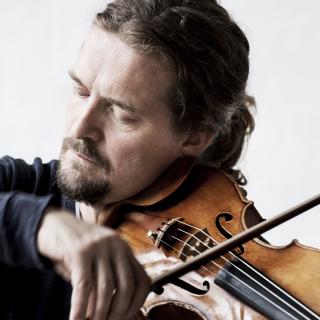
Christian Tetzlaff
Violinist Christian Tetzlaff is highly acclaimed for his expressive, insightful and personal interpretations. Since his spectacular debut with the Schönberg violin concerto in 1988 in Berlin, he has appeared with major orchestras of the highest calibre such as New York Philharmonics, the Boston and Chicago Symphony Orchestras, the Royal Concertgebouw Orchestra, London Symphony Orchestra and many others.
Tetzlaff performs an extensive repertoire ranging from Bach’s solo sonatas and partitas to lesserknown concertos by Giovanni Battista Viotti, to contemporary works by György Ligeti, and Thomas Adès. Chamber music has also been an integral part of his career. In 1994 he founded the Tetzlaff Quartet with his sister, cellist Tanja Tetzlaff.
In 2023 Tetzlaff took over the artistic direction of the Spannungen Festival in Heimbach, Germany. In the 2025/26 season he features as Artist-in-Residence of the Rundfunk-Sinfonieorchester Berlin. February 2026 Tetzlaff gives the world premiere of Ondřej Adámek’s Violin Concerto No. 2 in Paris.
Timo Kalliokoski
Violin 1
Pekka Kauppinen
Sara Etelävuori
Kreeta-Julia Heikkilä
Eija Hartikainen
Katariina Jämsä
Helmi Kuusi
Elina Lehto
Jani Lehtonen
Kari Olamaa
Elina Viitasaari
Dhyani Gylling
Alexis Mauritz
Harry Rayner
Ruben Goesch
Violin 2
Teija Kivinen
Heini Eklund
Teppo Ali-Mattila
Matilda Haavisto
Sirkku Helin
Liam Mansfield
Krista Rosenberg
Virpi Taskila
Celina Blasco Broniz
Katinka Korkeala
Viola
Petteri Poijärvi
Liisa Orava
Torsten Tiebout
Aulikki Haahti-Turunen
Carmen Moggach
Hajnalka Standi-Pulakka
Laura Világi
Laura Paakkari
Ana Robles Galindo
Ulla Soinne
Cello
Lauri Kankkunen
Tuomas Ylinen
Beata Antikainen
Veli-Matti Iljin
Fransien Paananen
Ilmo Saaristo
Saara Särkimäki
Woo Suk Jeong
Bass
Ville Väätäinen
Tuomo Matero
Paul Aksman
Henri Dunderfelt
Taavi Korhonen
Teemu Kauppinen | Flute
Niamh McKenna
Päivi Korhonen
Jenny Villanen
Oboe
Paula Malmivaara
Jussi Jaatinen
Clarinet
Samuel Buron-Mousseau
Anna-Maija Korsimaa
Bassoon
Mikko-Pekka Svala
Tuukka Vihtkari
Erkki Suomalainen
Horn
Ruben Buils Garcia
Miska Miettunen
Mika Paajanen
Sam Parkkonen
Trumpet
Thomas Bugnot
Mika Tuomisalo
Trombone
Victor Álvarez Alegria
Valtteri Malmivirta
Anu Fagerström
Tuba
Ilkka Marttila
Timpani
Mikael Sandström |