Concerto
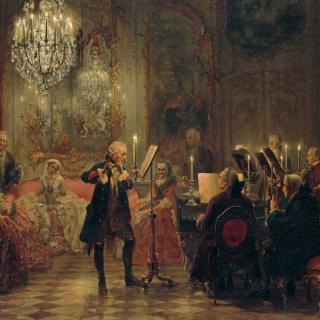
At the centre of the image is King Frederick II the Great, an enthusiastic amateur flautist, playing a concerto. An orchestra accompanying by candlelight is to the right, and Carl Philipp Emanuel Bach is seated behind the harpsichord, leading the orchestra.
A concerto is a work for soloist and orchestra. Concerts typically have three movements, named after their tempo.
Fast first movement
The first movement of a concerto is often in sonata form (see Movement structures). Towards the end of the movement there is an extensive passage for the soloist known as a cadenza.
Slow second movement
The slow second movement is a contrast to the first and last movements, often the quietest moment in the concerto. Slow movements are often in ABA form.
Fast third movement
The third movement typically contains the most virtuoso flair. It is often faster than the first movement and gives the work a rousing conclusion.
Béla Bartók: Violin Concerto No. 2
Ludwig van Beethoven: Piano Concerto No. 4
Johannes Brahms: Violin Concerto, Piano Concerto No.2
Antonín Dvořák: Cello Concerto
Edward Elgar: Cello Concerto
Felix Mendelssohn: Violin Concerto
W. A. Mozart: Piano Concerto No. 1-27, Violin Concerto No. 1-5, Horn Concerto No. 1-4, Oboe Concerto, Clarinet Concerto
Sergei Rahmaninov: Piano Concerto No. 2
Robert Schumann: Piano Concerto
Jean Sibelius: Violin Concerto
Pjotr Tšaikovski: Piano Concerto
Antonio Vivaldi: Le Quattro Stagioni