John Williams has created a musical identity in galaxies far, far away where Star Wars are fought, but he is also a prolific composer of concert music.
John Williams loves the dark sound of the viola and believes it is far too rarely heard as a solo instrument. He has contributed to the cause by writing a viola concerto. The work's second movement is titled “The Family Argument” in which the viola and the percussion settle their differences in a small duet.
Dmitri Shostakovich’s Seventh and Eighth Symphonies were grand, warlike and heroic. The Ninth was expected to be even grander and more warlike. But the work that was completed in August 1945 was surprisingly – and to the disappointment of some – short, light and humorous. The composer himself reflected: “Musicians will love to play it and critics will delight in blasting it.”
Duration appr. one hour, no interval. Please note that both video and audio recordings will be made of the performance.
Leonard Bernstein: Overture to Candide
Leonard Bernstein (1918–1990) was one of the greatest conductors of the past century, an accomplished pianist and a beloved host of music programmes on TV. He was of course also a composer, even if this is sometimes overlooked even today. Although he wrote plenty of ‘serious’ music, such as three symphonies and a violin concerto, as a composer he is routinely filed under ‘popular’ music. Critical reception of his works reflected the spirit of the post-war times: mainstream art was heavy on reason and logic and dismissive of the approach favoured by Bernstein, i.e. to capture the soul of the listener without passing through the cerebral cortex.
Bernstein the composer is best remembered for his musicals West Side Story (1957) and On the Town (1944) and for his score for the film On the waterfront starring Marlon Brando (1954). Candide (1956/1973/1989), a Broadway operetta based on the eponymous satire by Voltaire, was laborious in its genesis and went through a number of facelifts. Its first production was a dud: it was cancelled after only 73 performances. By comparison, West Side Story had a run of 732 performances plus a tour.
The Overture to Candide is one of the most popular concert overtures. Bernstein himself conducted it for the first time with the New York Philharmonic in concert in January 1957, and within two years it had been performed by some 100 orchestras. This is scarcely surprising, as it is an upbeat satirical whirlwind that updates Rossini’s theatrical comedy to a new and urban lifestyle with irresistible appeal.
John Williams: Concerto for Viola and Orchestra
John Williams (b. 1932) is one of the last great film composers whose music is firmly rooted in the ideals of the golden era of Hollywood. He is also undisputedly the most successful, with 27 Grammies and five Academy Awards (out of 54 nominations) to his credit. His best-known works are probably his scores for the Star Wars franchise, Schindler’s List, the Indiana Jones films and the Harry Potter films. His career has spanned some 70 years, and he has written the music for more than 120 feature films and 25 TV series.
Although Williams’s concert music, like his film scores, draws on late Romantic tonal melodies and emotion-eliciting harmonies, his solo concertos feature modernist rhythms and harmonies more prominently. Hollywood is never far, though, especially in the rich brass sound of the orchestral passages. To be fair, though, American music is typically heavy on brass.
Williams wrote his Concerto for Viola and Orchestra (2009) for Cathy Basrak, who premiered it with the composer conducting the Boston Pops Orchestra in May 2009. The work is in three movements. In the first, the soloist is timid and tentative, allowing the orchestra to claim space often and robustly; the solo cadenza towards the end is meditative but very much a virtuoso showcase with its double stops. The second movement escalates into a ‘family squabble’ between the viola and timpani. The finale gradually descends to the peace that was only hinted at in the first movement.
Dmitri Shostakovich: Symphony no. 9 in E flat major
What Dmitri Shostakovich (1906–1975) really thought about things is and remains a mystery. The West saw him as a tool of the Communist regime whose principal goal was to polish the bloodstained shield of his overlords. In the Soviet Union, he was a celebrated Hero of the People. His memoirs, published posthumously by journalist Solomon Volkov (Testimony, 1979), provided an utterly different perspective: here, the composer claimed to have opposed Stalin in every way he could, mainly by hiding critical barbs between the lines. The authenticity of this narrative was questioned immediately after publication and continues to be debated to this day. We will probably never know the truth.
Officially, in any case, Shostakovich worked for the propaganda machine of the regime, willingly or not. His grand wartime symphonies, the Seventh (1941) and Eighth (1943), boosted morale and were admired far and wide, even across the Atlantic — after all, the USA and the USSR were allies at the time. Shostakovich’s Ninth Symphony (1945) was expected to continue the series of patriotic works, but the composer went in another direction. This symphony is humorous (though the joy seems forced at times), bringing a ray of light into a dark time.
Allusions to the war are found mainly in the martial rhythms of the first movement, although these come across as tin soldiers marching to the tune of a Haydn-like frolic. The second movement features melancholy solos, while the third movement is a fleet-footed scherzo. The fourth and fifth movements are like night and day: a sombre elegy melting into the utterly dark irony of the finale.
Caleb Young
Caleb Young is an American conductor who excels in bringing both American and European classical music to life. Young has received mentorship under maestros such as Jukka-Pekka Saraste, Esa-Pekka Salonen and Hannu Lintu. He regularly works with John Williams and Gustavo Dudamel.
Highlights of the 25-26 season include Young’s debut with The Halle Orchestra in Manchester, and concerts with Opera North Orchestra, Kansas City Symphony and Iceland Symphony. He also returns to Fort Wayne Philharmonic, with which he had an impactful eight-year tenure. Young was instrumental in founding orchestra’s innovative “Music and Mixology” series, which continues to engage new audiences.
During the pandemic, Young expanded his influence through a radio show on National Public Radio that brings classical music to a broader audience. A graduate of Indiana University’s Jacobs School of Music, Young holds a Master of Music in Orchestral Conducting. His pedagogues include David Effron, Arthur Fagen and John Ratledge.
Antoine Tamestit
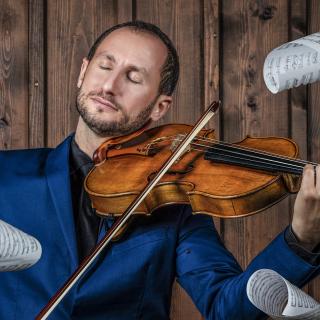
Antoine Tamestit stands as a singular voice in the world of classical music, redefining what it means to be a viola player in the 21st century. He has premiered major contemporary works by composers such as Jörg Widmann, Thierry Escaich, Bruno Mantovani, and Olga Neuwirth. A passionate advocate for new music, Tamestit believes that performing contemporary works is essential to keeping the viola repertoire vibrant and evolving.
Tamestit’s 25/26 season includes returns to London Symphony Orchestra, Chicago Symphony Orchestra, Royal Concertgebouw Orchestra, Cleveland Orchestra, Gewandhausorchester Leipzig, and Orchestre de la Suisse Romande.
Born in Paris, Tamestit studied with Jean Sulem, Jesse Levine, and with Tabea Zimmermann. In 2022, he received the prestigious triennial Hindemith Prize of the City of Hanau in recognition of his contribution to contemporary landscape within classical music. Antoine Tamestit plays on the very first viola made by Antonio Stradivarius in 1672.
On the stage today
Violin 1
Pekka Kauppinen
Lina Leikola
Eija Hartikainen
Katariina Jämsä
Maiju Kauppinen
Helmi Kuusi
Ilkka Lehtonen
Jani Lehtonen
Kari Olamaa
Petri Päivärinne
Kalinka Pirinen
Satu Savioja
Aada Kuoppa
Ángeles Salas Salas
Emilia Karjunen
Violin 2
Anna-Leena Haikola
Anna Husgafvel
Kamran Omarli
Teppo Ali-Mattila
Heini Eklund
Dhyani Gylling
Matilda Haavisto
Sirkku Helin
Liam Mansfield
Krista Rosenberg
David Seixas
Virpi Taskila
Sari Deshayes
Leena Jaakkola
Viola
Torsten Tiebout
Atte Kilpeläinen
Carmen Moggach
Petteri Poijärvi
Kaarina Ikonen
Mariette Reefman
Liisa Orava
Iiro Rajakoski
Markus Sallinen
Hajnalka Standi-Pulakka
Riitta-Liisa Ristiluoma
Laura Világi
Cello
Lauri Kankkunen
Beata Antikainen
Jaani Helander
Mathias Hortling
Ilmo Saaristo
Saara Särkimäki
Nadja Barrow
Johannes Välja
Alli Mankkinen
Pekka Smolander
Bass
Ville Väätäinen
Oskari Hänninen
Paul Aksman
Eero Ignatius
Tuomo Matero
Adrian Rigopulos
Henri Dunderfelt
Jon Mendiguchia | Flute
Elina Raijas
Jenny Villanen
Georgii Petrov
Oboe
Nils Rõõmussaar
Simeon Overbeck
Clarinet
Samuel Buron-Mousseau
Anna-Maija Korsimaa
Heikki Nikula
Sonja Lankinen
Bassoon
Markus Tuukkanen
Erkki Suomalainen
Mikko-Pekka Svala
Horn
Ville Hiilivirta
Miska Miettunen
Joonas Seppelin
Satu Huuskonen
Trumpet
Marco Cubillas Bolado
Obin Meurin Trombone
Víctor Álvarez Alegría
Anu Fagerström
Jussi Vuorinen
Tuba
Ilkka Marttila
Timpani
Tomi Wikström
Percussion
Tuomas Siddall
Mikael Sandström
Alex Martin Agustin
Jani Niinimäki
Harp
Katilyne Roels
Keyboard
Anna Kuvaja |