Japanese pianist phenomenon Hayato Sumino plays to sold-out audiences from Tokyo to London, Berlin to New York.
The Helsinki Philharmonic Orchestra premiered the Fifth Symphony of Jean Sibelius at a concert celebrating the composer's 50th birthday in December 1915 at the Great Hall of the University of Helsinki. The concert was conducted by the hero of the day himself, and it was a roaring success. There was no end to the congratulatory speeches, flower deliveries and addresses.
Fans of pianist Hayato Sumino also line up to meet their idol. Sumino has entered the Guinness World Records for the “most tickets sold for a solo piano recital (indoors)”. In November 2025, Sumino performed a concert at the Yokohama K-Arena in Japan, for which 18,564 tickets were sold.
The concert soloist's encore was Nikolai Kapustin's "Toccatina" from 8 Concert Études, Op. 40, No. 3, and the orchestra's encore was Jean Sibelius's Nocturne from the suite Belshazzar's Feast.
Jean Sibelius: Music from the suite Pelléas and Mélisande, Op. 46
Moving on from his youthful chamber music, Jean Sibelius (1865–1957) wrote his earliest orchestral works as incidental music for plays and tableaux. In a neat symmetry, his very last published orchestral work was a suite from his incidental music to Shakespeare’s The Tempest. His greatest hits, Finlandia and Valse triste, also began life as accompaniments to stage performances. His incidental music to Maurice Maeterlinck’s play Pelléas and Mélisande (1905) was commissioned by the Swedish Theatre in Helsinki.
Maeterlinck’s play was premiered in Paris in 1893, and several prominent composers soon took an interest in it. Within a decade, Gabriel Fauré, Arnold Schönberg and Claude Debussy had undertaken to add new layers of expression to the symbolism-laden rather static original. Sibelius remained faithful to the misty, insinuating style of the play, which favoured psychological tension over plot twists. A concert suite incorporating nearly all of Sibelius’s incidental music for the play was published in the year of its premiere; today’s programme includes four movements from it.
Rugged and evoking chivalry, the overture ‘At the Castle Gate’ leads us into the world of a love triangle. A melancholy oboe solo introduces ‘Mélisande’, a young woman in an unhappy marriage found by her future spouse Golaud at a forest stream. A dance-like ‘Intermezzo’ precedes a scene where Pelléas and Mélisande agree on a secret tryst. ‘Death of Mélisande’ concludes the play with a tear-jerking farewell.
Sergei Prokofiev: Piano Concerto No. 3 in C major, Op. 26
When the young Sergei Prokofiev (1891–1953) crashed his way onto the music scene in St Petersburg, the 1,000-year Imperial regime in Russia was crumbling, and the world around it was careening into a world war. The mechanical musical delivery of this piano virtuoso who had no time for convention and tradition reflected the spirit of the times: Romantic notions were a thing of the past, and powerful dissonances now ruled the day. With his first two Piano Concertos (1912 and 1913), Prokofiev divided critics into fans and foes; what was undisputed was that no one had ever heard such a hammering on the piano.
Prokofiev assembled his Piano Concerto No. 3 (1921) like a patchwork quilt, stitching together disparate sketches from a period of eight years. The work is a colourful mix of styles: passages echoing Prokofiev’s early modernism are interspersed with suave and sarcastic Neo-Classicism. The ultimate shape of the piece was no doubt influenced by Prokofiev’s emigration to the USA, a move that tended to smooth out the rough edges of European composers. When the work was premiered with Prokofiev as soloist in Chicago in December 1921, it was coolly received. However, it soon became a showcase piece for Prokofiev, and he recorded it in 1932.
The Concerto is in three movements. It begins with an innocent orchestral pastorale soon overwhelmed by fiery scales on the piano – indeed, the entire movement is a battle of opposites. The second movement varies a gavotte theme in turns both sardonic and mystical. The finale lets the pianist off the leash with devastating effect.
Jean Sibelius: Symphony No. 5, Op. 82
Many of the major works of Jean Sibelius (1865–1957) went through several laborious revisions before attaining their final form. His Violin Concerto, the tone poems Lemminkäinen, En Saga and The Bard and his First Symphony, to name a few, were premiered in versions that Sibelius subsequently felt he could not allow to stand.
Probably the most famous example of this, however, is his Fifth Symphony (1915–1919), which Sibelius spent a total of seven years writing and which had no fewer than three premieres. When he conducted the premiere of the first version of the Symphony, in four movements, he was already a celebrated national hero, and the work was of course received with acclaim. Yet he himself was not happy with it. In his rewrites, he strove for an increasingly integrated musical form where everything would be linked to everything else and not a single thematic occurrence would remain unjustified. The ultimate final version of the Fifth, premiered nearly four years after the first, became the high point of Sibelius’s symphonic development and the most frequently performed of all his symphonies.
Cast in three movements, the work presents its very limited set of materials on winds at the outset, motifs appearing out of the blue like rays of the sun penetrating the horizon. Soon they are fighting for space against a dark cloud cover, until the two combine forces and the heavens open to a blaze of fanfares. The second movement is a subdued set of variations whose tunes presage the finale, particularly its celebrated ‘swan theme’. The Symphony ends strangely, as if the composer were suddenly calling it quits in the midst of an ecstatic culmination. Is this what frustration sounds like?
Jaani Länsiö
Translation: Jaakko Mäntyjärvi
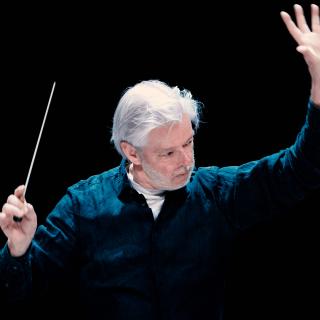
Jukka-Pekka Saraste
Jukka-Pekka Saraste, Chief Conductor and Artistic Director of the Helsinki Philharmonic Orchestra, has established himself as one of the outstanding conductors of his generation. Born in Finland in 1956, he began his career as a violinist. Today, he is renowned as an artist of exceptional versatility and breadth.
Saraste has previously held principal conductorships at the WDR Symphony Orchestra in Cologne, the Oslo Philharmonic Orchestra, the Finnish Radio Symphony Orchestra, the Toronto Symphony Orchestra, and the Scottish Chamber Orchestra, and has served as Principal Guest Conductor of the BBC Symphony Orchestra. As a guest conductor, he appears with major orchestras worldwide, including the Orchestre de Paris, the London Philharmonic Orchestra, the Staatskapelle Berlin, the Cleveland Orchestra, the New York Philharmonic Orchestra, and the Symphony Orchestras of Boston, Chicago, and San Francisco.
Coaching and mentoring young musicians is of great importance to Saraste. He is a founding member of the LEAD! Foundation, a mentorship programme for young conductors and soloists.
www.jukkapekkasaraste.com
Hayato Sumino
Japanese pianist Hayato Sumino (b. 1995) has gained an international following both on stage and online, where he reaches more than 2.2 million followers. He has performed with major orchestras including the NHK Symphony Orchestra, Tokyo Philharmonic Orchestra, Netherlands Radio Philharmonic Orchestra, Baltimore Symphony Orchestra and Chicago Symphony Orchestra. In 2024, he received the Leonard Bernstein Award of the Schleswig-Holstein Music Festival and two Opus Klassik Awards.
In November 2025, Sumino made history by giving the first piano recital at Yokohama’s K-Arena. With more than 18,000 tickets sold, the performance was recognised by Guinness World Records as the largest indoor piano recital ever held.
Recent highlights include his debut at the Beijing Music Festival performing Prokofiev’s Third Piano Concerto with the BBC Philharmonic under John Storgårds.