Johannes Brahms composed four symphonies, but today we will hear the “Fifth Symphony”, a piano quartet that is chamber music on a symphonic scale.
The Helsinki Philharmonic Orchestra’s audience has embraced conductor Michael Sanderling. After a previous visit, Helsingin Sanomat reported that Sanderling conducted so passionately that the audience erupted in enthusiastic cheers at the end of the performance.
Robert Schumann composed Piano Concerto for his wife Clara, who had urged him to write more than just songs and music for solo piano: “Don’t take it amiss if I tell you that I’ve been seized by the desire to encourage you to write for orchestra. Your imagination and your spirit are too great for the weak piano.”
Lili Boulanger: D’un matin de printemps
French composer Lili Boulanger (1893–1918) was born into a musical family. Her sister Nadia (1887–1979) became a celebrated teacher and also a composer. Lili studied the organ and music theory at the Conservatoire de Paris while also taking lessons in voice, violin, cello and harp. In 1913, she became the first woman to win the distinguished Prix de Rome with her cantata Faust et Hélène.
Boulanger’s life was fraught with illness and came to an early end. Her death at the age of only 24 is one of the greatest tragedies in the history of Western classical music. While her output remained limited, it demonstrates that she was unarguably a highly talented and original composer.
In 1917, already very frail, Boulanger wrote two pieces intended as a diptych: D’un matin de printemps and D’un soir triste. She completed three versions of both the ‘spring morning’ and ‘sad evening’: for duo, for piano trio and for orchestra. The orchestral version of D’un matin de printemps was the last piece that Boulanger completed before her death in 1918. The music understandably has a melancholic tinge, but also a measure of elevated spirit and humour. The piece was premiered in Paris in March 1921.
Robert Schumann: Piano Concerto in A minor Op. 54
Of all the composers of the Romantic period, Robert Schumann is possibly the most romantic. Like many of his contemporaries, he was fascinated by love and death, doppelgangers, ghosts, nocturnal moods and nature mysticism. But his life was overshadowed by periods of manic depression alternating with bursts of frenzied activity: in one year alone he composed no fewer than 138 solo songs.
The emphasis in his compositions is clearly on his inner voices, not outward displays of virtuosity – a feature reflected in his three concertos, for piano, cello and violin. The Piano Concerto in A minor, Op. 54 was based on the Fantasia in A minor for piano and orchestra of 1841. Though his pianist wife Clara Wieck was impressed when she tried it out with an orchestra, his publisher rejected it. In 1845 he added two movements – an Intermezzo and a Finale – and the three-movement concerto was premiered in Leipzig the following year. Intimate and melodic by nature, it avoids grand gestures even in the cadenza.
Johannes Brahms / Arnold Schönberg: Piano Quartet no. 1 in G minor
Johannes Brahms (1833–1897) had a skill for combining Romantic expressiveness with traditional forms and strict counterpoint. This had a major influence on the music and thinking of Arnold Schönberg (1874–1951), so much so that Schönberg penned an essay describing Brahms as progressive, as opposed to him usually being described as a conservative composer. Schönberg also orchestrated Brahms’s Piano Quartet no. 1 in G minor op. 25.
Brahms’s Quartet was premiered in Hamburg in 1861. It is a beautiful example of his chamber music, which despite being absolute music is always melodic and emotionally appealing. The best known of the four movements of this work is the rollicking rondo finale.
Schönberg orchestrated the Piano Quartet in 1937, having fled the Nazi regime to the United States. He explained in a letter: “It is always very badly played, because the better the pianist, the louder he plays, and you hear nothing from the strings. I wanted once to hear everything, and this I achieved.”
This arrangement could be dismissed as a curiosity if it did not so obviously show a deep respect and love for the original. There are instruments in the orchestra that Brahms would never have used, such as a xylophone, but this just serves to emphasise the underlying philosophy of the arrangement: Brahms is a composer for all ages. Schönberg’s arrangement, sometimes referred to as ‘Brahms’s Fifth Symphony’, was premiered under Otto Klemperer in Los Angeles in 1938.
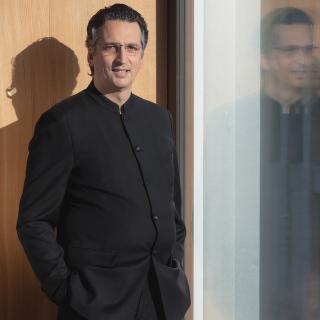
Michael Sanderling
Michael Sanderling has served as Chief Conductor of the Lucerne Symphony Orchestra since 2021. His appointment followed a long-standing, successful collaboration, with the shared aim of further developing the orchestra’s focus on late Romantic repertoire, including works by Bruckner, Mahler, and Strauss.
As a guest conductor, Michael Sanderling leads renowned orchestras worldwide, including the Berlin Philharmonic, the Leipzig Gewandhaus Orchestra, the Royal Concertgebouw Orchestra, the Orchestre de Paris, and the NHK Symphony Orchestra. From 2011 to 2019, he was Chief Conductor of the Dresden Philharmonic. Prior to this, he served as Chief Conductor of the Kammerakademie Potsdam from 2006 to 2011.
Michael Sanderling is deeply committed to nurturing young musical talent. He teaches at the Frankfurt University of Music and Performing Arts and collaborates regularly with the Schleswig-Holstein Festival Orchestra. From 2003 to 2013, he was Chief Conductor of the Deutsche Streicherphilharmonie.
Laura Mikkola
Pianist Laura Mikkola lives in Paris and performs extensively in Europe and beyond. She is particularly known as a profound connoisseur and interpreter of Eino-Juhani Rautavaara. She has recorded all of Rautavaara's piano concertos and solo piano works, as well as works composed for solo piano by Einar Englund.
Having won numerous piano competitions at the age of under 20, Mikkola has worked with the most renowned conductors, such as Esa-Pekka Salonen, Hannu Linnu, Leif Segerstam, Paavo Järvi, Vladimir Ashkenazy and Ahmed El-Saed. In 2024, Laura Mikkola was elected a Steinway Artist in Hamburg, Germany. The title is given to the best pianists of their era.
Mikkola founded the Iitti Music Festival in 2003 and has been the festival's Artistic Director ever since.
On the Stage Today
Violin 1
Kreeta-Julia Heikkilä
Lina Leikola
Ilkka Lehtonen
Katariina Jämsä
Maiju Kauppinen
Helmi Kuusi
Jani Lehtonen
Petri Päivärinne
Kalinka Pirinen
Satu Savioja
Elina Viitasaari
Sirkku Helin
Pauline Fleming-Unelius
Leena Jaakkola
Katinka Korkeala
Tuuli Talvitie
Violin 2
Anna Husgafvel
Teija Kivinen
Kamran Omarli
Teppo Ali-Mattila
Heini Eklund
Serguei Gonzalez Pavlova
Dhyani Gylling
Matilda Haavisto
Linda Hedlund
Liam Mansfield
Krista Rosenberg
David Seixas
Virpi Taskila
Jun Liu
Viola
Petteri Poijärvi
Carmen Moggach
Tuomas Huttunen
Kaarina Ikonen
Tiila Kangas
Liisa Orava
Iiro Rajakoski
Markus Sallinen
Hajnalka Standi-Pulakka
Olli Kilpiö
Laura Paakkari
Tuukka Susiluoto
Cello
Tuomas Ylinen
Beata Antikainen
Jaani Helander
Ilmo Saaristo
Saara Särkimäki
Nadja Barrow
Johannes Välja
Oona Koivukangas
Sami Mäkelä
Päivi Paajanen
Bass
Ville Väätäinen
Adrian Rigopulos
Jon Mendiguchia
Eero Ignatius
Paul Aksman
Tuomo Matero
Henri Dunderfelt
Yordano Nunez | Flute
Niamh McKenna
Enna Puhakka
Jenny Villanen
Oboe
Nils Rõõmussaar
Jussi Jaatinen
Paula Malmivaara
Clarinet
Samuel Buron-Mousseau
Anna-Maija Korsimaa
Heikki Nikula
Bassoon
Mikko-Pekka Svala
Alan Davidson
Erkki Suomalainen
Horn
Ville Hiilivirta
Joonas Seppelin
Satu Huuskonen
Mika Paajanen
Trumpet
Obin Meurin
Michael Olsen
Mika Tuomisalo
Trombone
Víctor Álvarez Alegría
Valtteri Malmivirta
Anu Fagerström
Tuba
Ilkka Marttila
Percussion
Tuomas Siddall
Mikael Sandström
Pasi Suomalainen
Teo de la Cruz
Alex Martin Agustin
Harp
Anni Kuusimäki
Keyboard
Minnaleena Jankko |