
Workout for the Ear x Sibelius
Like each of us, Sibelius developed and changed over the years as a person and a composer. This is also reflected in his works. Let us now examine what signs of this change we can hear on his path as a composer who constantly developed his skills.
Let's approach Sibelius' tone language through four different orchestral works by listening to his compositional style:
- What kind of orchestral music Sibelius composed at first – 1st Symphony
- How Sibelius’s orchestral music developed – 4th Symphony, 5th Symphony
- Where Sibelius’s music ultimately took us with his final orchestral works – Tapiola
Jean Sibelius: Symphony No. 1 in E minor
Jukka-Pekka Saraste, conductor
Helsinki Philharmonic Orchestra
Sibelius x Saraste Series
Sibelius was completing his postgraduate studies in Berlin when he composed his first symphony. This composition was of particular importance, as it would be performed 19 times on a European tour with what is today the Helsinki Philharmonic Orchestra under the baton of Robert Kajanus, culminating at the Paris Exposition in the summer of 1900.
The work has the four-part structure and musical language of a traditional symphony, as one would expect from a composer completing his postgraduate studies. The beginning of the first movement is, however, already idiosyncratic and a departure from tradition: instead of a spectacular symphonic opening, a solitary clarinet accompanied by only a timpani is heard. What exactly follows from this, the listener is led to ponder.
“The First Symphony is the energetic music of a young man. The young Sibelius was no wimp; the music contains the whole wildness and rage of the man.”
Osmo Vänskä, conductor 1998
Jean Sibelius: Symphony No. 4 in A minor
Susanna Mälkki, conductor
Helsinki Philharmonic Orchestra
Sibelius is 45 years old. He had faced his own mortality with a tumour found on his vocal cords. It was the impetus for an eight-year period of sobriety and abstinence from cigars, as well as several intimate and enigmatic works dealing with death and grief. The Fourth Symphony's tone language is more experimental, and the work makes the listener wait a moment before revealing where the melody and harmonic foundation are anchored.
Jean Sibelius: Symphony No. 5 in E flat major
Osmo Vänskä, conductor
Helsinki Philharmonic Orchestra
The first version of Sibelius's Fifth Symphony was performed on his 50th birthday in 1915. The work is luminous and exceptional in both its structure and tone language: it has only three movements, the last two of which are merged together, and the style varies widely without breaking the structure. You can read about the structure of a traditional symphony here. Although the composer himself felt increasingly critical toward his works, the symphony became one of his most beloved pieces. Its festive theme engages listeners from one decade to the next.
Jean Sibelius: Tapiola, Op. 112
Jukka-Pekka Saraste, conductor
Helsinki Philharmonic Orchestra
Sibelius is 61 years old when Tapiola is premiered in New York. The tone language has matured into its own voice and combines both modern tone language and national themes with a more tonal musical tradition. Sibelius had already composed seven symphonies before Tapiola. The composer's self-criticism is approaching a point beyond which it is impossible for him to be satisfied with his work in the symphonic form. Although he will live for many years after composing Tapiola, it would be his last major orchestral work.
Would you like to explore the music of Sibelius in more detail? Here is a playlist we have prepared for you to get acquainted with:
If you would like to expand your listening experience, listen to an entire symphony and the entire violin concerto.
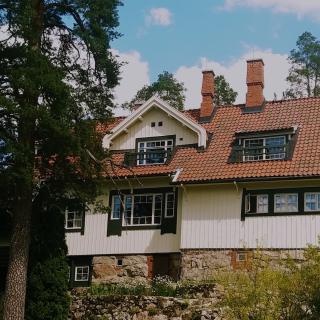
Photo: Paasikivi - Oma teos, CC BY-SA 4.0
Text: Satu Simola