
Symphony
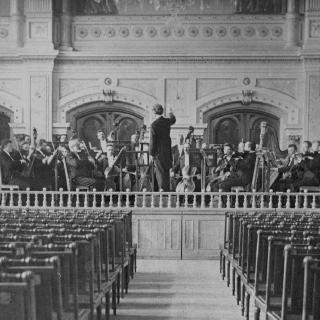
The image shows the Helsinki Philharmonic in 1900, conducted by its founder Robert Kajanus.
A symphony is an orchestral work, typically with four movements. It has a structure similar to that of a concerto, but with an added movement in triple time before the finale.
Fast first movement
The first movement of a symphony is usually in sonata form and may begin with a slow introduction.
Slow second movement
The second movement contrasts with the first and is often the quietest moment in the symphony.
Triple-time third movement
The third movement of a symphony is typically a minuet or a scherzo, in triple time (see Movement structures).
Fast fourth movement, finale
The fourth movement is the brilliant conclusion. There is much more variation in form among final movements than is found among first movements.
Famous Symphonies
Ludwig van Beethoven: Symphonies No. 1–9
Hector Berlioz: Symphonie Fantastique
Anton Bruckner: Symphonies No. 7–9
Antonín Dvořák: Symphonies No. 7–9
Joseph Haydn: Symphonies No. 1-105
Gustav Mahler: Symphonies No. 1-9
Felix Mendelssohn: Symphony No. 4
W. A. Mozart: Symphonies No. 1–41
Jean Sibelius: Symphonies No. 1–7
Pjotr Tšaikovski: Symphonies No. 4-6