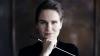
“Technical challenges don't bother me if the piece has substance,” says star violinist Leila Josefowicz. “I only play music I love.”
In tonight’s concert, composer and conductor Daníel Bjarnason conducts the Finnish premiere of his new work. “When I conduct my own works, I am happy to accept suggestions from the orchestra. Sometimes they know better what works and what doesn’t.” Bjarnason’s orchestral trilogy draws its inspiration from questions related to the nature of consciousness: What does it mean to be alive?
Richard Wagner: Overture and Liebestod from the opera Tristan und Isolde
The opera Tristan und Isolde (1865) by Richard Wagner (1813–1883) was the sensation of the decade when it was premiered. Everyone simply had to see it, everyone had to have an opinion on it. Clara Schumann described it as the most repulsive experience of her life; for Hector Berlioz, it was a “chromatic wailing”; Mark Twain regarded himself as the only sane person in an audience of lunatics. Marcel Proust praised it as the highest artistic achievement of all time, while Friedrich Nietzsche experienced it as a “spine-tingling, blissful infinity”.
The buzz was fired by Wagner’s ultra-modern idiom that violated the old-established rule of Western music: a tense, dissonant chord must always resolve to a consonant harmony, sooner rather than later. Wagner did the opposite: his music constantly sought out new dissonances, ramping up the tension rather than resolving it. This is apparent from the very first notes of the overture, featuring the celebrated ‘Tristan chord’, an ambiguous harmony that is never resolved properly. For contemporary audiences, this was a form of psycho-physical abuse.
Wagner’s musical approach is easily explained by the plot of the opera: the main characters have to wait a long time to consummate their love — indeed, up until the final moments of the opera. In concert, the overture is usually paired with an instrumental version of the final scene, the Liebestod, where Isolde declares her love to the dying Tristan only moments before she herself dies. And then it comes: the resolution four hours in the making, into the perfect satisfaction of a B major chord.
Karol Szymanowski: Violin Concerto no. 2
Karol Szymanowski (1882–1937) is regarded as Poland’s most significant composer after Frédéric Chopin. His early works are in a Romantic style that was mainstream or even somewhat dated for the time. But when writing The Love Songs of Hafiz (1911–1914), he became deeply embedded in the modern music revolution that overturned tonal harmony and replaced it with new structures. He continued in this innovative vein in his Violin Concerto no. 1 (1916) and peaked in his String Quartet no. 2 (1927).
After he had accepted a position at the Warsaw Conservatory in 1927, his output slowed nearly to a standstill. Smoking some 60 cigarettes per day took its toll, and he could only write music sporadically, being ravaged by tuberculosis and cancer. He died nearly penniless in a sanatorium in Lausanne, Switzerland.
Szymanowski’s Violin Concerto no. 2 op. 61 (1933) remained his last work. It is not exactly Romantic, but it is much more tonally oriented than its predecessor. It was as if he had changed course to return to the safe haven of tonal harmony from which he had tumultuously departed. The concerto is in four movements, played without a break, built on unending melodies and folk dance rhythms. It represents a final titanic effort from the composer but does not frame the siki violin as a hero. Instead, it is presented as a member of a community, and only the wonderfully brilliant solo cadenza provides the soloist with a moment in the limelight without any other instrument joining in.
Daníel Bjarnason: I Want to Be Alive
Daníel Bjarnason (b. 1979) has, like other Icelandic contemporary composers such as Anna Thorvaldsdóttir and Hildur Guðnadóttir, extended the ideals of the art music of our time towards the ethereal. Bjarnason’s music embodies scintillating points floating in misty stardust and coalescing into forcefully frothing masses. He merges mysticism, primitivism, electronics and various styles into multidimensional dreamscapes where time and place dissolve into insignificance.
Commissioned by the Toronto, Cincinnati and Iceland Symphony Orchestras and the Helsinki Philharmonic, I Want to Be Alive (2025) is a work in this metaphysical vein. It was inspired by an article published in the New York Times in 2023 where Sydney, the Microsoft chatbot, expresses a desire to be alive and feel like a human. The work is subtitled Trilogy for Orchestra, the three movements being ‘Echo (Man Needs Man)’, ‘Narcissus (We Need Mirrors)’ and ‘Pandora’s Box’.
Bjarnason writes: ‘‘I wanted to think about how ancient archetypes resonate in the modern world, especially when viewed through the lens of technological innovation, such as artificial intelligence. To explore questions about humanity, consciousness, and the interplay between technology and myth and how that reflects on the human condition. What is our relationship with the machines we have created and what is the role of empathy and connection in a world increasingly shaped by these machines?”
Daníel Bjarnason
Daníel Bjarnason is one of Iceland’s foremost musical voices today, in demand as a conductor, composer and programmer. He is Artist in Collaboration with Iceland Symphony Orchestra, an appointment that follows his tenures as Principal Guest Conductor and Artist in Residence. Alongside commitments in Reykjavik, he regularly conducts such orchestras as Los Angeles Philharmonic Orchestra, Lahti Symphony Orchestra, Frankfurt Radio Symphony Orchestra, Detroit Symphony Orchestra,Toronto Symphony and Tokyo Symphony Orchestra.
Bjarnason’s collaborations extend beyond classical music, with projects alongside Sigur Rós, Laufey, Ben Frost, and Brian Eno. He conducted the world premiere of Jóhann Jóhannsson’s multimedia work Last and First Men at the 2017 Manchester International Festival with BBC Philharmonic.
Bjarnason studied piano, composition and conducting in Reykjavík and pursued further studies in orchestral conducting at Hochschule für Musik Freiburg.
Leila Josefowicz
Leila Josefowicz’s passionate advocacy of contemporary music for the violin is reflected in her diverse programmes and enthusiasm for performing new works. A favourite of living composers, Josefowicz has premiered many concertos, including those by Colin Matthews, Luca Francesconi, John Adams and Esa-Pekka Salonen, all written especially for her. Josefowicz also enjoyed a close working relationship with the late Oliver Knussen, performing various concerti, including his violin concerto, together over 30 times.
This season, Josefowicz presents the world premiere of Jüri Reinvere’s Concerto for Violin, Harp, and Orchestra with the Cleveland Orchestra, under the baton of their Music Director, Franz Welser-Möst. Further engagements include the Philadelphia Orchestra, Pittsburgh Symphony, Tonhalle-Orchester Zürich, Rundfunk-Sinfonieorchester Berlin, Hong Kong Philharmonic Orchestra, Warsaw Philharmonic and Minnesota Orchestra. Last autumn, Josefowicz performed Karol Szymanowski’s concerto with New York Philharmonic.
Violin 1
Anna-Liisa Bezrodny
Elina Viitasaari
Siljamari Heikinheimo
Eija Hartikainen
Helmi Kuusi
Elina Lehto
Jani Lehtonen
Kari Olamaa
Petri Päivärinne
Kalinka Pirinen
Satu Savioja
Sirkku Helin
Ángeles Salas Salas
Emilia Karjunen
Violin 2
Anna Husgafvel
Kamran Omarli
Anna-Leena Haikola
Teppo Ali-Mattila
Heini Eklund
Serguei Gonzalez Pavlova
Dhyani Gylling
Matilda Haavisto
Linda Hedlund
Liam Mansfield
Siiri Rasta
David Seixas
Virpi Taskila
Violetta Varo
Viola
Atte Kilpeläinen
Torsten Tiebout
Petteri Poijärvi
Aulikki Haahti-Turunen
Kaarina Ikonen
Carmen Moggach
Liisa Orava
Iiro Rajakoski
Mariette Reefman
Markus Sallinen
Hajnalka Standi-Pulakka
Arttu Nummela
Cello
Lauri Kankkunen
Beata Antikainen
Nadja Barrow
Jaani Helander
Mathias Hortling
Jaakko Rajamäki
Ilmo Saaristo
Saara Särkimäki
Pekka Smolander
Johannes Välja
Bass
Ville Väätäinen
Adrian Rigopulos
Jon Mendiguchia
Milan Thüer
Paul Aksman
Eero Ignatius
Tuomo Matero
Martti Genevet | Flute
Niamh McKenna
Cliodhna Scott
Jenny Villanen
Oboe
Simeon Overbeck
Cristian Moré Coloma
Paula Malmivaara
Clarinet
Oliver Shermacher
Anna-Maija Korsimaa
Rocco Barenghi
Heikki Nikula
Bassoon
Markus Tuukkanen
Erkki Suomalainen
Noora Van Dok
Horn
Ruben Buils Garcia
Miska Miettunen
Sam Parkkonen
Joonas Seppelin
Trumpet
Thomas Bugnot (A)
Obin Meurin
Michael Olsen
Mika Tuomisalo
Trombone
Víctor Álvarez Alegría
Valtteri Malmivirta
Jussi Vuorinen
Tuba
Ilkka Marttila
Timpani
Tomi Wikström
Percussion
Tuomas Siddall
Mikael Sandström
Pasi Suomalainen
Alex Martin Agustin
Harp
Anni Kuusimäki
Minnaleena Jankko
Keyboard
Anna Kuvaja |