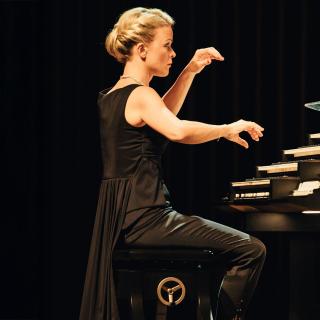
Sebastian Fagerlund named his organ concerto Ad Spiram, ‘towards the spiral’. The soloist for the premiere is renowned Latvian organist Iveta Apkalna.
“Ad Spiram, loosely translated from Latin, means ‘towards the spiral’ or ‘towards the vortex’,” says Sebastian Fagerlund, explaining the title of his organ concerto. “The Latin word ‘spirare’ means to breathe. These two meanings were strongly in my mind during the composition phase. I have had an abstract image of columns of air that intertwine in a spiral and the idea of the instrument itself that breathes.”
“When I discovered the music of Anton Bruckner and Gustav Mahler in my late teens, I knew that there was something here that I wanted to understand completely.” Bruckner’s music has become important to Jukka-Pekka Saraste over the years. “He was a humble person with an incredible will beneath the surface. This duality in his personality inspired me greatly.”
Sebastian Fagerlund: Ad Spiram
Sebastian Fagerlund (b. 1972) is creating a successful international career with energetically mobile and darkly lyrical music. His idiom incorporates recognisable influences from modernism but also from heavy metal and film music in a kind of pluralism that comes naturally for composers of Fagerlund’s generation. His output includes orchestral works, solo concertos, chamber music and vocal music. Audiences in Helsinki know him above all as an opera composer, as he scored a hit at the Finnish National Opera with his opera Höstsonaten (Autumn Sonata, 2015–2017), based on the film by Ingmar Bergman. He followed on from this success with the equally well received Morgonstjärnan (The Morning Star, 2025), based on a novel by Karl Ove Knausgård, premiered early in the current year.
Fagerlund wrote his organ concerto Ad Spiram, being given its world premiere in this programme, to a joint commission from the Helsinki Philharmonic Orchestra, the Polish National Radio Symphony Orchestra, the Gothenburg Symphony Orchestra and the Dresden Philharmonic Orchestra. The work is dedicated to Iveta Apkalna.
The composer writes: “Ad Spiram, loosely translated from Latin, means ‘towards the spiral’ or ‘towards the vortex’. The Latin word ‘spirare’ means ‘to breathe’. These two meanings were strongly in my mind during the composition phase. I have had an abstract image of columns of air that intertwine in a spiral and the idea of the instrument itself that breathes.”
Anton Bruckner: Symphony no. 6 in A major
Anton Bruckner (1824–1896) was mocked by critics nearly all his life, and his Sixth Symphony, completed in 1881, made no exception. After the premiere of its 2nd and 3rd movements in Vienna, Eduard Hanslick, outraged, wrote in his review: “It has become ever harder for me personally to achieve a proper relationship with these peculiar compositions in which clever, original, and even inspired moments alternate frequently without recognisable connection with barely understandable platitudes, empty and dull patches, stretched out over such unsparing length as to threaten to run players as well as listeners out of breath.”
The Symphony was not premiered in full until after Bruckner’s death, in 1899, and even then several cuts to the score had been made by the conductor, Bruckner’s pupil Gustav Mahler. The original, uncut version was premiered in Stuttgart in 1901.
Bruckner often felt compelled to revise his works time and time again, but the Sixth Symphony forms an exception. We might be justified in concluding that for once he thought he had got something right on the first attempt. The Symphony has four movements, typically for Bruckner. The first movement and the scherzo are infused with infectious kinetic energy, while the slow movement evokes an atmosphere of sanctity. The finale is a journey with twists and turns, culminating in the triumphant return of the main subject of the first movement.
Christian Holmqvist
Translation: Jaakko Mäntyjärvi
Iveta Apkalna
Latvian organist Iveta Apkalna (b. 1976) is widely regarded as one of the leading organists of her generation. Since 2017, she has served as titular organist of Hamburg’s Elbphilharmonie, inaugurating the hall’s Klais organ at its opening concerts. Since 2019, she has also been Artist-in-Residence at the Concert Church in Neubrandenburg as part of the Mecklenburg-Vorpommern Festival.
Apkalna’s international breakthrough came in 2008 with a performance alongside the Berlin Philharmonic under Claudio Abbado. She has since appeared with major orchestras including the Bavarian Radio Symphony Orchestra, Royal Concertgebouw Orchestra, Los Angeles Philharmonic, Royal Stockholm Philharmonic Orchestra, Cleveland Orchestra and Tonhalle-Orchester Zürich.
She is also frequently invited to inaugurate new organs around the world, most recently in Prague, Katowice and Kaohsiung. Among her recent highlights are performances of Esa-Pekka Salonen’s Sinfonia Concertante with the Chicago Symphony Orchestra under the composer’s direction.
Jukka-Pekka Saraste
Jukka-Pekka Saraste, Chief Conductor and Artistic Director of the Helsinki Philharmonic Orchestra, has established himself as one of the outstanding conductors of his generation. Born in Finland in 1956, he began his career as a violinist. Today, he is renowned as an artist of exceptional versatility and breadth.
Saraste has previously held principal conductorships at the WDR Symphony Orchestra in Cologne, the Oslo Philharmonic Orchestra, the Finnish Radio Symphony Orchestra, the Toronto Symphony Orchestra, and the Scottish Chamber Orchestra, and has served as Principal Guest Conductor of the BBC Symphony Orchestra. As a guest conductor, he appears with major orchestras worldwide, including the Orchestre de Paris, the London Philharmonic Orchestra, the Staatskapelle Berlin, the Cleveland Orchestra, the New York Philharmonic Orchestra, and the Symphony Orchestras of Boston, Chicago, and San Francisco.
Coaching and mentoring young musicians is of great importance to Saraste. He is a founding member of the LEAD! Foundation, a mentorship programme for young conductors and soloists.