
Pathétique

Wed 02/09/2026 19:00 - 21:00
8.00€
49.50€

Presentation

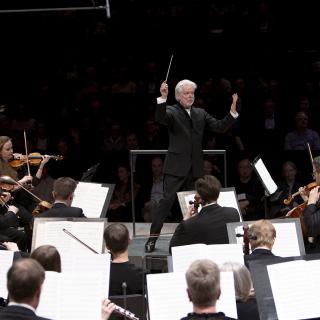
The Helsinki Philharmonic Orchestra and Chief Conductor Jukka-Pekka Saraste invite you to a concert to feel, think, enjoy and be moved.

Sergei Prokofiev himself was the soloist at the premiere of his Second Piano Concerto. “I went to bow to the audience twice and heard both cheers and boos from the hall. I was delighted that my concerto aroused such strong emotions in the audience.” Today’s soloist is the young Finnish-Cuban pianist Anton Mejias, who has gained a foothold on international stages in recent years. 

The evening begins with a work by Cecilia Damström inspired by Russian troll factories and disinformation. She composed it applying Morse code to the musical notation from beginning to end. 

Pyotr Tchaikovsky declared that he had put nothing more and nothing less than his whole soul into his Sixth Symphony.


Cecilia Damström: Information

Cecilia Damström (b. 1988) finds topics for her works in issues of profound importance for humanity and society at large. “We live in a world with huge societal and environmental issues, and I have a need to participate in this debate,” she says. The topics she has addressed cover a wide range: to take a few examples, Nixus (2020) is about mental health problems, Wasteland (2022) is about fast fashion, and the Teosto Prize winning ICE (2021) is about melting glaciers.

Information (2024) addresses influencing through information. The material for the piece is built out of English-language words interpreted in Morse code and as musical pitches: Truth, Lies, Fear, Blame, War, Peace, Unity, United and Humanity. In the course of the 10-minute piece, the orchestra delivers a maelstrom of more than 47,000 notes, reflecting the relentless onslaught of (dis)information in social media. Damström says: 

“Josef Goebbels, the Nazi propaganda chief, is said to have said more than a century ago: ‘Repeat a lie often enough and it becomes the truth.’ Unfortunately, he seems to have been right, as we can see in world politics even today. When I read Putinin trollit [Putin’s trolls] by Jessikka Aro and Doppelgänger by Naomi Klein, I understood how disinformation is used to divide people. It came as a surprise to me to learn that certain countries spend hundreds of millions of dollars each year to spread disinformation. Music has the unique ability to bring us together, and we need this more acutely than ever in today’s polarised world.”

Serge Prokofiev: Piano Concerto No. 2 in G minor op. 16

The young Serge Prokofiev (1891–1953) was an enfant terrible with no reverence at all for the classics of the piano, undermining convention with hammered dissonances and aggressive tumult. His provocative, powerful virtuoso writing was calculated to cause discomfort in the audience. An enjoyment to some, immediately disgusting to others, his music always prompted a strong reaction of some kind.

Prokofiev made his reputation particularly with his concertos. He entered the Rubinstein Piano Competition with his Piano Concerto no. 1 (1911) so that the jury would be unable to determine whether he played the piece well or badly. And he won. The premiere of Piano Concerto No. 2 (1913) ended in a shouting match between Prokofiev’s defenders and detractors. We do not know exactly what it was that the audience reacted thus to, since the original orchestral parts of the concerto were destroyed in a fire in 1917. Prokofiev made substantial changes to the orchestral setting in the 1920s but retained the piano part as is. It is known as one of the most demanding in the entire piano concerto repertoire.

The first movement opens with a tentative theme that grows slowly but inexorably towards a piano cadenza, a solo lasting more than five minutes and culminating in a series of uncontrolled explosions. In the brief second movement, the pianist is required to deliver a flurry of music on both hands at about 600 notes per minute, with the orchestra contributing jabs in the background. The finale has meditative moments, but its tempo indication, ‘tempestuously fast’ says all we need to know about its fundamental nature.

Pyotr Tchaikovsky: Symphony No. 6 in B minor, Op. 74, Pathétique

The struggles of Pyotr Tchaikovsky (1840–1893) with his sexual identity came to a head in 1878. His marriage of convenience to a young female pupil of his fell apart before it had even properly begun. He was obliged to admit that he was a homosexual, albeit only to himself, yet to be on the safe side and to avoid scandal, he fled to Switzerland and Italy in order to be able to work without fear of rumours and persecution. This crisis propelled Tchaikovsky’s creativity to new heights. The biographical content that crept into his symphonies resulted in an increasingly dramatic and profound overall tone.

Tchaikovsky’s last three symphonies are about illicit, fatal love which the will of an individual is powerless to resist. The Sixth Symphony (1893) was the final blow in the tragedy, mirrored in real life in very concrete terms, as Tchaikovsky died a little more than a week after the premiere. There were speculations that he was either murdered or forced to commit suicide because of the exposure of his relationship with a young male relative; it is more likely, however, that he died of cholera. The coincidences, considered too great to ignore, have kept people guessing to this day.

The subtitle ‘Pathétique’ was proposed for the Symphony by the composer’s brother Modest. To us it is an unfortunate mistranslation, since in Russian the word does not mean pompous or pathos-laden but emotional or passionate. The Symphony begins with a blazing declaration of love but eventually turns to unfathomable despair, perhaps even death.

Jaani Länsiö

Translation: Jaakko Mäntyjärvi

Artists

Jukka-Pekka Saraste
conductor
Anton Mejias
piano

Program

    19:00
    21:00
    Cecilia Damström
    Information
    Sergei Prokofjev
    Piano Concerto No. 2
    Intermission
    Pjotr Tšaikovski
    Symphony No. 6 ”Pathétique”
Series I
Musiikkitalo Concert Hall
Jukka-Pekka Saraste
Anton Mejias
Cecilia Damström
Information
Sergei Prokofjev
Piano Concerto No. 2
Intermission
Pjotr Tšaikovski
Symphony No. 6 ”Pathétique”