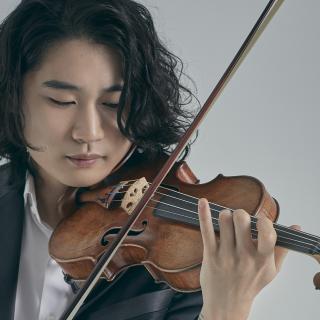
Inmo Yang, winner of the 2022 Jean Sibelius Violin Competition, makes his long-awaited return visit. Johannes Brahms’ Violin Concerto is one of the most beloved of its kind.
Music critics around the world unanimously praise the same remarkable aspect of violinist Inmo Yang’s playing: its phenomenal sound. It has “an almost cello-like warmth and depth” (The Arts Desk, 2023); it is “lovely bloom during sustained passages and lean, silvery colorings during fleet ones” (The New York Times; 2016) or then it is just simply “sweet” (Chicago Tribune, 2017).
Richard Strauss wrote his own musical characterisations in his tone poem A Hero’s Life, representing, among others, his wife Pauline, as well as the music critics he hated. The autobiographical nature of the tone poem about heroism led critics to denounce the work as a "monstrous” display of selfishness.
Johannes Brahms: Violin Concerto in D major, Op. 77
Johannes Brahms (1833–1897) boldly bucked mainstream trends. While many of his contemporaries swore by programme music in the Romantic vein, Brahms remained faithful to the ideals that dictated that subjective content was to be sublimated within the bounds of strict formal architecture. It is thus no surprise that he wrote a large number of pieces in the spirit of the Classical era: string quartets, piano trios, violin sonatas and symphonies. His four solo concertos – two for piano, one for violin and one for violin and cello – are also heavy on musical substance and avoid party tricks designed to make the audience’s jaws hit the floor.
Brahms wrote his Violin Concerto for his friend, violin virtuoso Joseph Joachim, in 1878. Joachim was a crucial influence on the shaping of the solo part, and he also wrote the demanding cadenza for the first movement. The work was premiered with Brahms conducting in Leipzig in 1879. The symphonically conceived concerto was received with mixed emotions, and several celebrated violinists refused to perform it, claiming that the solo part was unidiomatically written. Today, every self-respecting violinist will have tackled the Brahms Concerto at least once in their career, and it remains one of the most popular and most frequently performed works in its genre. The upbeat finale, infused with Hungarian tones, is familiar even to those who do not otherwise listen to classical music.
Richard Strauss: Ein Heldenleben, Op. 40
Richard Strauss (1864–1949) wrote ten tone poems combining colourful orchestration with fantastic stories and a rich late Romantic idiom. The eighth of these, Ein Heldenleben (Life of a hero), was completed in parallel with Don Quixote in 1898. The latter is based on the eponymous novel about the Knight of the Sorrowful Countenance by Cervantes, and Ein Heldenleben was intended as a complement to it in the sense that it, too, is about a heroic main character. Here, however, the hero is Richard Strauss himself. For this reason, the work was dismissed as egomaniacal in its first performances. Attitudes are different today, since it is pretty much de rigueur for a composer to cast themselves as the heroic main character of their own lives, as we can see every day on social media: composers romanticise their life as an artist, promote their works and publish details about their private lives, all in the interests of creating a compelling public narrative. It is much the same thing that Strauss voiced in connection with Ein Heldenleben: “I am just as interesting as Napoleon.”
This tone poem is both a homage to and a parody of the hero myths of art music; it is both outrageously self-centred and playfully self-ironic. Its six movements form a dynamic arc under which the hero faces mockery from critics but also spends time with his nagging wife. Finally, he withdraws from the chaos of the world.
Christian Holmqvist
Translation: Jaakko Mäntyjärvi
Eva Ollikainen
Conductor Eva Ollikainen is one of the leading conductors of our time. She has held previous positions as Chief Conductor and Artistic Director of the Iceland Symphony Orchestra, and Chief Conductor of the Nordic Chamber Orchestra.
The 2026/2027 season sees Ollikainen debut with the New York Philharmonic, National Symphony Orchestra Washington, Bamberger Symphoniker, hr Sinfonieorchester, Orchestre national du Capitole de Toulouse, Sydney Symphony Orchestra, Melbourne Symphony Orchestra, and Singapore Symphony Orchestra, among others. She also returns Los Angeles Philharmonic, Swedish Radio Symphony Orchestra and Wiener Symphoniker alongside further international engagements. She also returned to the BBC Proms with the BBC Symphony Orchestra and led the Iceland Symphony Orchestra on their European tour.
Curious about contemporary music, Eva Ollikainen has performed a wide range of repertoire with the Iceland Symphony during her tenure as Chief Conductor. In April 2026, Ollikainen and the Iceland Symphony Orchestra released Arvo Pärt: Complete Symphonies on Chandos to critical acclaim.
A former student of Leif Segerstam and Jorma Panula at the Sibelius Academy, Ollikainen won the Jorma Panula Conducting Competition at the age of 21. Today, the support of young musicians is close to her heart. She teaches regularly at the Sibelius Academy and leads masterclasses around Europe.
Inmo Yang
South Korean violinist Inmo Yang (b. 1995) first gained international recognition by winning the Premio Paganini Competition in Genoa in 2015 as its youngest participant. He also received prizes for the audience favourite and best performance of a contemporary work. In 2022, Yang won the International Jean Sibelius Violin Competition. He also received a special prize for his performance of Magnus Lindberg’s commissioned work Caprice.
Yang has since appeared with leading orchestras including the New York Philharmonic, Los Angeles Philharmonic, Orchestre National de France, Orchestre de la Suisse Romande, BBC Symphony Orchestra, Dresdner Philharmonie, Hong Kong Philharmonic Orchestra and Seoul Philharmonic Orchestra.
Yang studied at Korea National University of Arts, the New England Conservatory in Boston, Kronberg Academy and the Hanns Eisler School of Music in Berlin. Yang performs on the 1743 “Carrodus” violin by Giuseppe Guarneri del Gesù, generously loaned by a member of the Stretton Society.