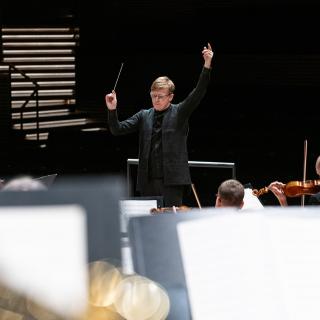
“The Four Seasons mostly consists of a good collection of folk tunes. And that's a compliment coming from me!” says Swedish folk musician Ale Carr.
Pekka Kuusisto has invited Swedish folk musician Ale Carr to accompany him in a performance of Vivaldi’s The Four Seasons. Carr plays the cittern, a variant of the lute. Pekka and Ale intertwine Italy’s oppressive midsummer heat, winter storms and spring birdsong with Nordic folk music.
Mikael Karlsson’s song cycle So We Will Vanish is written and dedicated to mezzo-soprano Anne Sofie von Otter. “It’s actually quite brilliant song cycle – think Björk with more resilient singing and more luxurious orchestration.” This is how the Swedish newspaper Dagens Nyheter (19.2.2021) described the work, which von Otter performs on concert stages around the world. The lyrics of So We Will Vanish were written by Royce Vavrek, and the orchestration was done by Michael P. Atkinson together with the composer.
Extra numbers among Vivaldi’s The Four Seasons, performed by Pekka Kuusisto and Ale Carr:
- Den blomstertid nu kommer with Anne Sofie von Otter.
- A short excerpt from the main theme of Beethoven’s 7th Symphony.
- A brief passage from Ralph Vaughan Williams’s The Lark Ascending.
- Hjortingen.¨
- Trad.
- Antin Mikon polska (trad.).
The encore was Ale Carr’s piece Malva.
Anna Thorvaldsdottir: CATAMORPHOSIS
Icelandic composer Anna Thorvaldsdottir (b. 1977), the Helsinki Philharmonic Orchestra’s Composer-in-Residence this year, has found her voice in dark, overpowering masses of orchestral sound that conjure up drama of cinematic proportions. Her music is not about specific narratives, but her titles often refer to mystical or cosmic metamorphoses — phenomena that the human mind cannot fully control even though it desires to do so. Metacosmos (2017) evokes a black hole, ARCHORA (2022) envisions a parallel reality and Dreaming (2008) floats on the logic of dreams.
CATAMORPHOSIS (2020) is a 22-minute descent into panic and terror — a reminder of the consequences of our choices. Unless we change our relationship to our planet and its condition, we may run out of time. The work is in a single movement, as is typical for the composer, but it is divided into seven main sections: ‘Origins’, ‘Emergence’, ‘Polarity’, ‘Hope’, ‘Requiem’, ‘Potentia’, ‘Evaporation’. The sections are not clearly defined, but each of them comes across as an accelerating spiral towards the next culmination.
“CATAMORPHOSIS is quite a dramatic piece, but it is also full of hope,” says Thorvaldsdottir. “Perhaps somewhere between the natural and the unnatural, between utopia and dystopia, we can gain perspective and find balance within and with the world around us.”
The work was the winner in the category of large orchestral works at the 2021 Ivors Composer Awards.
Mikael Karlsson: So we will vanish
Swedish composer Mikael Karlsson (b. 1975) has lived in the USA since 2001, creating a diverse career in concert music, contemporary dance, ballet, opera, video art and games. His music for the Battlefield games is one of his best-known creations. Karlsson rarely works alone, having collaborated for instance with Anna von Hausswolff on the multimedia orchestral work Grand Guignol and with Michael P. Atkinson on the ballets Mary, Queen of Scots and Coppélia. Atkinson also orchestrated Karlsson’s song cycle So we will vanish, setting texts by Canadian opera librettist Royce Vavrek.
Commissioned by Anne Sofie von Otter, these songs were initially intended as a commentary on climate change, but Karlsson wished to avoid moralising. Instead, the songs focus not on humans but on the environment — its continuous and inexorable disappearance as part of the cycle of nature. The work was premiered at a concert of the Swedish Chamber Orchestra under Michael Collins in February 2021.
The three songs in the cycle reflect on the destruction of life from the perspective of individual trees. The first is about the experience of a tree washed into the sea in Doggerland, a region that sank into the North Sea. The second is about a tree besieged by black kites in Australia, and the third is about the species Nesiota elliptica, which grew on the remote island of St Helena and which despite efforts could not be saved: the last surviving individual died in 2003.
Antonio Vivaldi: Le quattro stagioni
The amazingly prolific Venetian composer Antonio Vivaldi (1678–1741) wrote some 50 operas, dozens of choral and chamber works and a plethora of sonatas. His most significant legacy, however, is his concertos: there are 500 or more of them, and their form and style laid the groundwork for the concerto genre for centuries to come. He also demonstrated that it is possible to tell stories in quite detailed narrative using instruments only. The four violin concertos collectively known as Le quattro stagioni, the Four Seasons, follow their respective narratives — evocative sonnets probably written by Vivaldi himself — astonishingly closely. Indeed, the works may be regarded as the earliest examples of programme music.
Spring begins with birdsong, babbling brooks and thunder. In the second movement, a herdsman falls asleep while his dog barks, and the finale is a dance at a country feast. In Summer, the first movement evokes oppressive heat, the second features a herdsman startled by outbursts of thunder and pestered by flies. In the concluding Presto, the storm finally breaks and destroys grain fields — a far cry from the gentle Finnish summer.
Autumn begins with a harvest dance, where energies fade as bottles are emptied. In the slow movement, the revellers have already fallen asleep. The finale is a new morning and a new beginning. Winter features icy rain in the form of pizzicatos and ornaments, and tremolos illustrating the chattering of teeth. The slow movement is a sort of 18th-century hygge sitting by the fireside, while the finale is a fearful journey skating on thin ice.
Pekka Kuusisto
Pekka Kuusisto (b. 1976) is one of Finland’s most renowned musicians. At the commencement of the Helsinki Philharmonic Orchestra’s 2025/26 concert season, Kuusisto began his third and final year as Principal Guest Conductor. Additionally, as Co-Artistic director, he is a member of the Artistic Leadership Team responsible for planning the programme. In the HPO’s concerts, Pekka Kuusisto will perform as a soloist, conductor, and also as a player-director at the front of the orchestra with his violin.
Pekka Kuusisto’s career as a solo artist took off in 1995 when he won the International Jean Sibelius Violin Competition at the age of 19. Since then, he has toured concert halls around the world. Kuusisto’s repertoire spans classical music to modern experiments. He improvises and composes, readily intertwining music with other art forms, aiming to make concerts more accessible and engaging for the audience.
In addition to Helsinki, he frequents Oslo (Norwegian Chamber Orchestra), Gothenburg (Gothenburg Symphony), and Bremen (Deutsche Kammerphilharmonie).
Kuusisto performs on the Antonio Stradivarius violin, “ex-Sandars”, Cremona 1695, generously loaned by the Anders Sveaas' Charitable Foundation, ASAF.
Anne Sofie von Otter
Swedish mezzo-soprano Anne Sofie von Otter’s versatility has seen her work with legendary artists ranging from the late greats of Carlos Kleiber, Claudio Abbado and Giuseppe Sinopoli to Elvis Costello and Brad Mehldau.
An ever-evolving repertoire has played a key role in sustaining Swedish-born von Otter’s international profile, from an early position as the superlative Octavian (Der Rosenkavalier) of her generation, to her acclaimed creation of Leonora in the world premiere of Thomas Adès’ The Exterminating Angel.
Maintaining a busy schedule, her 2025/26 season include recital tours to North America with long-term collaborator Kristian Bezuidenhout presenting Schubert’s Schwanengesang. She will add the role of the Baroness in performances of Vanessa with Boston Symphony Orchestra.
Ale Carr
Swedish born cittern maestro, Ale Carr, has performed worldwide on venues as varied as the Sydney Opera House, Royal Albert Hall, Roskilde Festival and in Hayao Miyazaki’s personal studio in Japan. Recipient of 10 Danish Music Awards, he has also been honoured with Composer of the Year award and with an Artist of the Year award in Denmark.
Ale Carr’s roots lie in Scania in the south of Sweden where he grew up in a family of folk musicians. The early exposure to lived folk music and dance remains as an enduring influence on his performance and how he interacts with colleagues and friends in music. Today, Ale is recognised as one of the leading string instrumentalists in Nordic folk music.
In 2009 together with the Danish virtuosos, Nikolaj Busk and Rune Tonsgaard Sørensen, he formed the trio Dreamers’ Circus. His various projects and collaborations include performances together with Pekka Kuusisto, Eskö Järvelä, and Danish String Quartet, to name a few.
Violin 1
Johannes Põlda
Kreeta-Julia Heikkilä
Sara Etelävuori
Pekka Kauppinen
Eija Hartikainen
Katariina Jämsä
Maiju Kauppinen
Helmi Kuusi
Jani Lehtonen
Kari Olamaa
Petri Päivärinne
Kalinka Pirinen
Satu Savioja
Dhyani Gylling
Aada Kuoppa
Sari Deshayes
Violin 2
Teija Kivinen
Anna-Leena Haikola
Kamran Omarli
Teppo Ali-Mattila
Heini Eklund
Serguei Gonzalez Pavlova
Matilda Haavisto
Linda Hedlund
Sirkku Helin
Siiri Rasta
Krista Rosenberg
Ángeles Salas Salas
Virpi Taskila
Katinka Korkeala
Kanerva Mannermaa
Tuuli Talvitie
Viola
Atte Kilpeläinen
Petteri Poijärvi
Mariette Reefman
Aulikki Haahti-Turunen
Kaarina Ikonen
Tiila Kangas
Carmen Moggach
Liisa Orava
Iiro Rajakoski
Hajnalka Standi-Pulakka
Saara Kurki
Arttu Nummela
Cello
Tuomas Ylinen
Beata Antikainen
Johannes Välja
Lauri Kankkunen
Jaani Helander
Veli-Matti Iljin
Ilmo Saaristo
Saara Särkimäki
Annika Valkeajoki
Sami Mäkelä
Hans Schröck
Iiris Tötterström
Bass
Maria Krykov
Eero Ignatius
Henri Dunderfelt
Vilhelm Karlsson
Paul Aksman
Ville Väätäinen
Taavi Korhonen
Tuomo Matero | Flute
Elina Raijas
Päivi Korhonen
Jenny Villanen
Oboe
Paula Malmivaara
Simeon Overbeck
Nils Rõõmussaar
Clarinet
Veera Myllyniemi
Anna-Maija Korsimaa
Heikki Nikula
Bassoon
Markus Tuukkanen
Sari Seppelin
Alan Davidson
Horn
Ruben Buils Garcia
Mika Paajanen
Sam Parkkonen
Joonas Seppelin
Trumpet
Thomas Bugnot
Mika Tuomisalo
Trombone
Victor Álvarez Alegria
Valtteri Malmivirta
Anu Fagerström
Tuba
Ilkka Marttila
Matthijs Leffers
Timpani
Mikael Sandström
Percussion
Tuomas Siddall
Pasi Suomalainen
Alex Martin Agustin
Harp
Minnaleena Jankko
Keyboard
Fanny Söderström |