Kurtág celebrates his 100th birthday in February 2026 and is still studying scores. “I can only really hear the music, from the inside, by reading it.”
In his composition ...quasi una fantasia… Kurtág disperses the orchestra’s musicians into a sparse formation around the stage, far from each other. “I wanted for musicians to not be able to discuss how bad the music was during rehearsals,” Kurtág says with a twinkle in the corner of his eye. The title of the piece refers to Beethoven, a composer very important to Kúrtag.
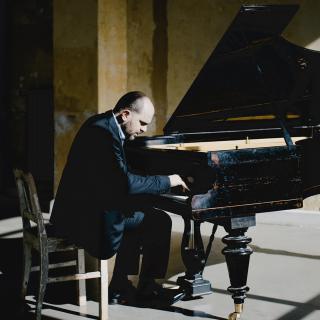
The evening’s piano soloist Kirill Gerstein finds a lot of humour in the music of Beethoven, despite his reputation for being grumpy: “In people’s minds, Beethoven shakes his fist at the sky, which is true, but there are also a lot of tricks and jokes.”
György Kurtág: …quasi una fantasia… op. 27:1
Hungarian composer György Kurtág (b. 1926) is one of the great composers of the 20th century. He is also known as a pianist and a teacher, and in 2012 he was awarded the Sibelius Prize of the Jenny and Antti Wihuri Foundation.
Kurtág’s music is all about conciseness and austerity: everything is communicated in a minimal handful of notes and gestures. Because of this, many of his works are fragments or clusters of fragments. But to deduce from this that he is dry and intellectual would be erroneous. His music is expressive and at times subtly humorous.
Kurtág’s ...quasi una fantasia... op. 27:1 was commissioned by the Berlin Festival Week and premiered in October 1988 with Zoltán Kovacs at the piano and Péter Eötvös conducting the orchestra. The title is an allusion to Beethoven’s Piano Sonata op. 27/1, and the music comes across as a scarcely coherent recollection of a traditional piano concerto.
A feature of interest in the piece is that the chamber orchestra is divided into groups distributed around the concert venue. Exciting tonal colour is created with instruments such as a dulcimer, a recorder, harmonics and bongo drums. ‘Introduction’ meditates on silence; ‘Presto minaccioso e lamentoso (Wie ein Traumeswirren)’ is a wild scherzo; ‘Recitativo’ is a dramatic funeral march; and ‘Aria’ is a sequence of dreamlike echoes from the past.
Ludwig van Beethoven: Piano Concerto no. 5 in E flat major ‘Emperor’
The piano featured prominently in the catalogue of compositions by Ludwig van Beethoven (1770–1827) from the 1780s to the end of his life. The cornerstone of his solo piano output is his set of 32 Piano Sonatas. He also wrote 20 sets of variations, three Rondos and numerous miniatures. Beethoven wrote six Piano Concertos, albeit he never published the earliest of these, a Concerto in E flat major written in 1784.
What would be Beethoven’s last Piano Concerto was completed in spring 1809 and was premiered at the palace of Prince Lobkowitz in Vienna. The soloist was Archduke Rudolf, a pupil of Beethoven’s, who is also the dedicatee. The public premiere was given by Friedrich Schneider in Leipzig 1811. The work was praised as original and impressive.
When the concerto was finally given its first performance in Vienna in 1812, the soloist was Carl Czerny. The reception here was polite but unenthusiastic. One critic wrote: “Beethoven is so self-confident that he does not write music for the masses. He demands of his audience a level of sophistication that only a small circle of experts can offer him.”
The sub-title ‘Emperor’ is by all accounts the brainchild of English publisher Johann Baptist Cramer. It is fitting, though, as the concerto is a work of grand and noble gestures. It is longer than was customary at the time at about 40 minutes, and Beethoven’s treatment of the cadenza in the first movement was also unusual. It was the practice at the time for the soloist to improvise a cadenza when performing a concerto, but here Beethoven wrote out the cadenza and added a note in the score: “Do not play [your own] cadenza, play this.”
The extensive opening movement (Allegro) begins with an introduction where the soloist warms up, as it were, before the music proper. The main subject is boldly confident, the second subject is lyrical. The piano also introduces a third subject, more energetic. Beethoven presents these themes in different guises and variants up until the end of the movement. The serene second movement (Adagio un poco moto) presages the nocturnes of the Romantic era. The bright and splendid rondo finale (Allegro ma non troppo) follows without a break.
Wolfgang Amadeus Mozart: Symphony no. 41 in C major ‘Jupiter’
Written in August 1788, the Symphony in C major KV 551 was the last symphony completed by Wolfgang Amadeus Mozart (1756–1791). At this point in his career, he would not have been writing ambitious orchestral music just for the fun of it. Even though he was a court composer to Emperor Leopold II, the court only commissioned him to write inconsequential dance music. It is therefore likely that the trio of symphonies written in summer 1788 (the two others being the Symphony in E flat major KV 543 and the Symphony in G minor KV 550) was intended for a specific concert or event. Music scholars disagree on whether Mozart actually heard the C major Symphony before his death. Perhaps it was performed in Vienna immediately after its completion, or perhaps in Leipzig in 1789. We do not know for certain.
This is the most extensive and most grandiose of Mozart’s symphonies. The subtitle ‘Jupiter’ was probably attached by English impresario J.P. Salomon. The work is full of light and joie de vivre, and as a technical achievement it far outpaced all of Mozart’s contemporaries.
The first movement (Allegro vivace) is characterised by its ceremonial opening gesture and an allusion to the humorous concert aria Un bacio di mano KV 541. The slow movement (Andante cantabile) introduces darker tones, not as a tragic narrative but simply as a contrast to the otherwise lucid music. The Minuet (Allegretto) is a carefree interlude, while the finale (Molto allegro) contains one of the most magnificent counterpoint passages ever devised in European classical music, with five themes seamlessly superimposed.
Pekka Kuusisto
Violinist, conductor and composer Pekka Kuusisto is renowned for his artistic freedom and fresh approach to repertoire. Kuusisto is Artistic Director of the Norwegian Chamber Orchestra, Principal Guest Conductor and Artistic Co-Director of Helsinki Philharmonic Orchestra, Principal Guest Conductor of the Gothenburg Symphony and Chief Conductor Designate of Tokyo Metropolitan Symphony Orchestra from April 2028.
Recent highlights include appearances with Mahler Chamber Orchestra, Leipzig Gewandhaus Orchester and Berliner Philharmoniker. An enthusiastic advocate for contemporary music and improvisation, he collaborates with artists from diverse backgrounds and engages in projects that blur conventional boundaries between genres.
Kuusisto performs on the Antonio Stradivarius violin, “ex-Sandars”, Cremona 1695, generously loaned by the Anders Sveaas' Charitable Foundation, ASAF.
www.harrisonparrott.com
Kirill Gerstein
Kirill Gerstein has emerged as one of today’s most compelling pianists. A searching and versatile artist, his repertoire spans Baroque suites, Classical concertos, contemporary works, jazz, and cabaret. He has performed several times with the Helsinki Philharmonic Orchestra.
Gerstein’s path began at fourteen, when he became the youngest student ever admitted to the Berklee College of Music. His international breakthrough came in 2001 with Brahms’s Piano Concerto No. 1 alongside the Tonhalle Orchestra Zurich, followed by First Prize at the Arthur Rubinstein International Piano Master Competition.
A true champion of contemporary music, Gerstein has commissioned and premiered works by composers including Timo Andres, Chick Corea, Alexander Goehr, Oliver Knussen, and Brad Mehldau. He gave the world premiere of Thomas Adès’s Piano Concerto in 2019 and has since performed it more than sixty times. Gerstein is Professor at the Hanns Eisler School of Music in Berlin and at the Kronberg Academy.
On the stage today
Violin 1
Pekka Kauppinen
Kreeta-Julia Heikkilä
Eija Hartikainen
Katariina Jämsä
Maiju Kauppinen
Helmi Kuusi
Elina Lehto
Jani Lehtonen
Kari Olamaa
Petri Päivärinne
Satu Savioja
Violin 2
Kamran Omarli
Teija Kivinen
Heini Eklund
Matilda Haavisto
Linda Hedlund
Siiri Rasta
Krista Rosenberg
Virpi Taskila
Pia Sundroos
Viola
Atte Kilpeläinen
Lotta Poijärvi
Petteri Poijärvi
Aulikki Haahti-Turunen
Kaarina Ikonen
Tiila Kangas
Mariette Reefman
Markus Sallinen
Cello
Lauri Kankkunen
Beata Antikainen
Saara Särkimäki
Mathias Hortling
Augustas Gocentas
Oona Koivukangas
Bass
Tuomo Matero
Svenja Dose
Paul Aksman
Henri Dunderfelt | Flute
Niamh McKenna
Elina Raijas
Oboe
Hannu Perttilä
Paula Malmivaara
Clarinet
Matteo Mastromarino
Anna-Maija Korsimaa
Heikki Nikula
Bassoon
Erkki Suomalainen
Mikko-Pekka Svala
Horn
Ruben Buils Garcia
Joonas Seppelin
Trumpet
Thomas Bugnot
Michael Olsen
Trombone
Valtteri Malmivirta
Tuba
Ilkka Marttila
Timpani
Mikael Sandström
Tomi Wikström
Percussion
Pasi Suomalainen
Donatien Conversat
Tommi Kiiski
Virva Kuusi
Alex Martin Agustin
Fabian Paul
Harp
Anni Kuusimäki
Keyboard
Minnaleena Jankko, celesta
Hans-Kristian Kjos Sørensen, cimbalom |