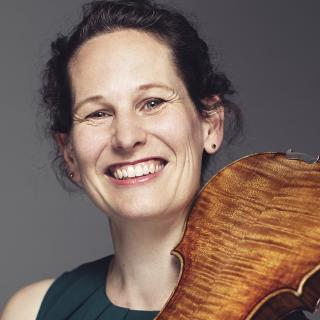
Violinist Malin Broman leads French music from three centuries and performs as soloist of one of the most challenging virtuoso pieces in music history.
“Paris is like a cesspool, its streets are muddy, its inhabitants are arrogant and they have bad taste.” The young Wolfgang Amadeus Mozart’s impressions of the City of Light were not flattering. However, during a visit to Paris in 1778, Mozart accepted a commission for a symphony, which he composed to suit the “noisy symphonic taste” of Parisians.
Twenty-six years later, Louise Farrenc was born in the same city. She grew up surrounded by sculptors, painters and artistic women. Farrenc became a concert pianist, composer and the only female professor at the Paris Conservatory in the 19th century.
Louise Farrenc: Overture no. 1 in E minor op. 23
Louise Farrenc (born Jeanne-Louise Dumont, 1804–1875) was a prominent French piano virtuoso and an accomplished composer. She was appointed Professor of Piano at the Conservatoire de Paris in 1842, and her collection of etudes op. 26 was required material for all piano students. In 1859, her daughter Victorine, also a pianist, died unexpectedly. It appears that Farrenc stopped writing music because of the shock, and her public performances became much less frequent.
Farrenc’s output as a composer consists mainly of chamber music, including two Piano Quintets, a Nonet, two Violin Sonatas and three Trios. Her music was popular and highly respected in her lifetime, and she was twice awarded the Prix Pierre Cardin by the Académie des Beaux-Arts. Yet on the other hand she was constrained by the social conventions of her time. For instance, she never gained a position as a teacher of composition — indeed, before 1870 the Conservatoire de Paris did not even allow women to study composition. As a concert pianist, she constantly found herself having to insist being paid the same as her male colleagues.
Farrenc’s most significant extensive works are her three symphonies and the two orchestral overtures she wrote in 1834. The first of these, op. 23, is replete with fiery drama and surprising twists.
Gabriel Fauré: Pelléas et Mélisande op. 80
The best-known play by Belgium’s Nobel Prize-winner Maurice Maeterlinck (1862-1949) is the symbolistic drama Pelléas et Mélisande (1892), a source of inspiration to many contemporary composers. The most famous version is Debussy’s opera of 1902. Schönberg also had plans for an opera on the theme but in the end wrote a symphonic poem, and Sibelius composed his Pelléas et Mélisande in 1905.
The incidental music by Gabriel Fauré (1845-1924) was composed as a commission for the London premiere of the play in English in 1898. He was too busy to provide more than a piano score, which was then orchestrated by his pupil Charles Koechlin. The production got an ecstatic reception and Fauré later arranged and himself orchestrated a suite of music from the play. For it he selected four of the 17 numbers.
The first is a melancholy Prelude. Fileuse begins act III with a portrait of Mélisande. The charming Sicilienne is possibly one of Fauré’s most familiar pieces. The Suite ends with La mort de Mélisande (The Death of Mélisande), which was also played at Fauré’s own funeral.
Maurice Ravel: Tzigane
Contrary to conventional wisdom, Maurice Ravel (1875–1937) was not an Impressionist — or at least not in the same sense as his contemporary Claude Debussy. Although Ravel did employ modern sonorities and introduced novelties into his musical grammar, he was principally interested in musical forms of the past and the spirit of history. He could thus be described as a Neo-Classicist. His retro trips were quite respectful, though, unlike those of Serge Prokofiev and Igor Stravinsky, who at times made an outright mockery of historical music.
Ravel’s music also incorporates geographical features in the sense that La Valse embodies the Vienna of a bygone era, Shéhérazade is set in exotic Persia and the Piano Concerto in G major captures the pulse of New York jazz. He was particularly fond of showcasing his Spanish roots on his mother’s side, particularly in the Rhapsodie espagnole and of course the Boléro. His orchestral rhapsody Tzigane (1924) combines both elements, being a Hungarian-tinted fantasy souvenir of an era that will never return. However, we cannot rule out the possibility of it being a parody.
Ravel conceived Tzigane after hearing violinist Jelly d’Aranyi improvise on the folk dances of her native land, even if those tunes were based on the music of the nomadic Roma rather than actual Hungarian folk music. Tzigane continues in the tradition of Johannes Brahms and Franz Liszt in presenting Hungarian music through the vehicle of a virtuoso violinist. The work is in two sections, beginning with an ominous, improvisation-like solo that holds the orchestra in check until the party finally gets into full swing.
Jean-Philippe Rameau: Suite from the opera Hippolyte et Aricie
Jean-Philippe Rameau (1683–1764) was a composer and the most prominent music theorist of his time. He was employed as an organist in Dijon, Paris and Avignon until he was nearly 40 years old. In 1722, he published his Traité de l'harmonie réduite à ses principes naturels, which remains a valid music theory textbook to this day. Propelled to fame by this treatise and by the virtuoso keyboard pieces he wrote thereafter, he is today remembered principally for the dozens of operas that he wrote, even though these came late in his career: he was 50 years old when he wrote his first opera, Hippolyte et Aricie (1733).
Based on Jean Racine’s play Phèdre (1677), the libretto narrates love tragedy from Greek mythology: Hippolytus, son of King Theseus, is in love with Aricia, but Theseus’s wife Phaedra is in love with him. Phaedra accuses Hippolytus of attempting to seduce her and is punished by the gods with madness. In the end, Aricia and Hippolytus are united. There are no fewer than 17 roles. The opera is in five acts and lasts some three hours.
When first performed, the opera was an opinion divider. Some marvelled at its bold orchestral colours and harmonies, while others felt it was an insult to the glory of composer Jean-Baptiste Lully and derided it as malformed, or ‘baroque’ — apparently the first time that this term was ever used to describe music.
As per the French tradition, dance numbers are quite as important as vocal numbers. The concert suite is made up of the overture and eight scenes, the best-known of which are the ‘Premier air des Furies’ from the Underworld act and the dances of the sailors and the hunters (‘Airs des matelots’ and ‘Airs des chasseurs’, respectively).
Wolfgang Amadeus Mozart: Symphony No. 31 “Paris”
In 1778, Mozart was able to take a respite from his life of drudgery in the service of the Bishop of Salzburg and head his horses for Paris. It was a city he had charmed only 15 years before as a Wunderkind, but this time he had to make do with cold inns and audiences. Not discouraged, he penned a symphony designed to suit French tastes. “Whether other people will like it I do not know,” he said. “I can vouch for the few intelligent French people who may be there; as for the stupid ones – I see no great harm if they don’t like it.” In other words, the Paris Symphony was a calculated hit, tailor-made to appeal to the tastes of the trendy and afford him an entry into society. It differs from his earlier symphonies in many ways. Now, for the first time, he used two clarinets, and he had a bigger orchestra than in Salzburg at his disposal. It has only three movements, because the French did not care for minuets.
The symphony was a great success. The audience applauded mid-movement and demanded an immediate encore of the string melody with pizzicato accompaniment in the first movement. A single hit could not carry him very far, however, and Mozart returned home to plan his next job-hunting excursion.
Malin Broman
Malin Broman is a violinist much in demand as a soloist, chamber musician, and orchestral leader. In 2008, she was appointed Concert Master of the Swedish Radio Orchestra.
During the period 2015–2020, Broman was the Artistic Director of Musica Vitae Chamber Orchestra. In 2019 she took up the post of Artistic Director for Ostrobothnian Chamber Orchestra, and in 2025 she began as Musical Director for Nordic Chamber Orchestra.
Devoted to chamber music, Broman is a founding member of the Kungsbacka Piano Trio, which was selected for both the BBC New Generation Artists Scheme and the European Concert Halls Organization. The trio has made its Carnegie Hall debut and appeared at major venues, including the Concertgebouw, Vienna Konzerthaus, and tours of Argentina, Australia, and Canada.
During the COVID period, her YouTube video of Mendelssohn‘s Octet, where Broman plays all eight parts, went viral. In 2019 she was awarded H.M. The King’s Medal for her services to music. Malin Broman plays a 1709 Stradivarius violin generously loaned by the Järnåker Foundation, a Candi viola and a Del Gesù Guarneri copy by Stephan von Baehr.
On the stage today
Violin 1
Anna Gebert
Pekka Kauppinen
Lotus Tinat
Katariina Jämsä
Maiju Kauppinen
Ilkka Lehtonen
Kari Olamaa
Kalinka Pirinen
Elina Viitasaari
Sirkku Helin
Leena Jaakkola
Violin 2
Anna-Leena Haikola
Teija Kivinen
Ángeles Salas Salas
Elina Lehto
Teppo Ali-Mattila
Serguei Gonzalez Pavlova
Linda Hedlund
Krista Rosenberg
Virpi Taskila
David Seixas
Viola
Torsten Tiebout
Ulla Knuuttila
Tuomas Huttunen
Tiila Kangas
Carmen Moggach
Mariette Reefman
Hajnalka Standi-Pulakka
Arttu Nummela
Cello
Lauri Kankkunen
Jaani Helander
Ilmo Saaristo
Pekka Smolander
Johannes Välja
Leonardo Chiodo
Bass
Ville Väätäinen
Svenja Dose
Jon Mendiguchia
Paul Aksman
| Flute
Niamh McKenna
Päivi Korhonen
Oboe
Paula Malmivaara
Jussi Jaatinen
Clarinet
Samuel Buron-Mousseau
Rocco Barenghi
Bassoon
Markus Tuukkanen
Erkki Suomalainen
Horn
Ville Hiilivirta
Miska Miettunen
Mika Paajanen
Sam Parkkonen
Trumpet
Thomas Bugnot (A)
Obin Meurin
Trombone
Víctor Álvarez Alegría
Anu Fagerström
Jussi Vuorinen
Timpani / percussions
Mikael Sandström
Harp
Anni Kuusimäki
Keyboard
Minnaleena Jankko, cembalo
Jouko Laivuori, celesta |