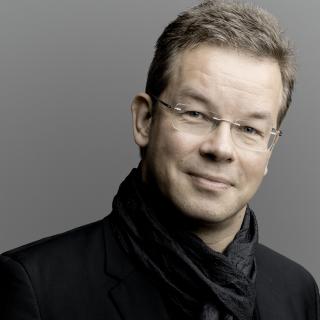
The Helsinki Philharmonic Orchestra, the Helsinki Music Centre Chorus and conductor Antony Hermus lead the audience into the festive season with the most profound music.
In the hour-long orchestral version of Richard Wagner's opera Tristan und Isolde, the spotlight is exclusively on the main characters, whose tragic love story is told from beginning to end in seven scenes.
Giuseppe Verdi, widely known as an opera composer, began his musical career at the age of 12 as organist for his village church. In his last years, he returned to his early church music roots in Four Sacred Pieces. The Helsinki Music Centre Chorus transforms into many roles, from a small a cappella ensemble to a double choir accompanied by orchestra.
Giuseppe Verdi: Quattro pezzi sacri
In 1872, Giuseppe Verdi (1813–1901) convinced the world that he had retired, following the success of his opera Aida. He was 58 years old at the time. As it turned out, he never stopped writing music during the remaining 30 years of his life. In this period, he wrote his celebrated Requiem (1874) and the operas Otello (1887) and Falstaff (1893). The four separately conceived sacred pieces that were published as a single work in 1898 under the title Quattro pezzi sacri (1889–1897) remained his final works.
Verdi was a church organist in his youth, and although he wrote several accomplished duets, trios, quartets and choral scenes in his operas, he was not known for writing polyphonic music as such. In his old age, he returned to the sounds of his youth – despite being a confirmed agnostic – and explored Renaissance and Baroque polyphony with great studiousness, particularly the styles of Palestrina and J.S. Bach. As a result, the Quattro pezzi sacri are very different from his operas and even from the Requiem.
‘Ave Maria’ is a technical tour de force of chromatic writing, written by Verdi as a response to an ‘enigmatic scale’ published by the Gazetta musicale di Milano, challenging its readers to add additional voices to it. Similar incisive tones appear in ‘Stabat mater’, which culminates in the words “Paradisi gloria”. ‘Laudi alla Vergine Maria’, which emulates a Renaissance style, is a setting of a text from ‘Paradise’ in Dante’s Divvina commedia. The concluding ‘Te Deum’ has a Gregorian chant as its foundation and rises to grand heights before concluding in profound, enigmatic final chords.
Richard Wagner / Henk de Vlieger: Tristan und Isolde – An Orchestral Passion
Tristan und Isolde (1859) by Richard Wagner (1813–1883) was the opera event of the century that one simply had to experience. It divided audiences broadly into two camps: some hated it with a vengeance, while others were transported to a near-religious experience. Wagner realised that he had hit a nerve: “I fear that the opera will be banned, unless it is turned into a parody by virtue of a bad production,” he wrote. “Only mediocre performances can save me! Successful performances invariably drive people mad.”
Perhaps the most plausible explanation for these extreme reactions was the unprecedented harmonic world of the opera, plunging the listener into unfamiliar waters from the very first with what is now known as the ‘Tristan chord’. From there onwards, the harmonic tension is never actually resolved until the final scene, subjecting contemporary ears to an excruciating denial of resolution for nearly five hours. This was, of course, not merely an exercise in music theory for Wagner: the extended delayed release was a tangible expression of the forbidden love of the main couple.
Composer Henk de Vlieger compiled an orchestral suite (1994) that condenses the opera into a one-hour love scene medley, focusing on the main couple and their passionate tribulations. Like the opera, the suite culminates in the most beautiful music that Wagner ever wrote, the Liebestod, where Tristan dies in Isolde’s arms: their love is finally consummated, and the audience is finally released from their torment in an unambiguous blaze of B major.
Jaani Länsiö
Translation: Jaakko Mäntyjärvi
Antony Hermus
Antony Hermus is known for his positive approach to music and his ability to inspire musicians. Having recently concluded his tenure as Chief Conductor of the Belgian National Orchestra, he continues his relationship with the ensemble as Conductor Laureate. From the 2027/28 season, he will become Chief Conductor of the BBC Scottish Symphony Orchestra.
A prominent figure in Dutch musical life, Hermus regularly conducts major orchestras including the Royal Concertgebouw Orchestra, Residentie Orkest, Netherlands Radio Philharmonic and Rotterdam Philharmonic. From 2015 to 2024, he was Principal Guest Conductor of the North Netherlands Orchestra and was later named Honorary Conductor for Life.
This season’s highlights include appearances with the Montreal and Vancouver Symphony Orchestras, Strasbourg Philharmonic, Royal Liverpool Philharmonic and Polish National Radio Symphony Orchestra, as well as Wagner’s Tristan und Isolde with Opera North. Hermus is also Visiting Professor at the Conservatorium van Amsterdam and Artistic Advisor to the National Youth Orchestra of the Netherlands.
www.antonyhermus.com
The Helsinki Music Centre Chorus
The Helsinki Music Centre Chorus is a symphonic choir of 130 singers that can also be transformed into a male or a female choir if necessary. The choir collaborates with the resident organisations of the Helsinki Music Centre: the Helsinki Philharmonic Orchestra, the Finnish Radio Symphony Orchestra and the Sibelius Academy of the University of the Arts Helsinki. The artistic director of the choir is the Professor of Choral Conducting Nils Schweckendiek. The choir was founded in 2011.
The choir’s repertoire consists of symphonic choral and orchestral works, complemented by a cappella works for a chorus. The repertoire covers all musical eras, including contemporary music. The programme is planned on a long-term basis in collaboration with the resident organisations of the Music Centre. The choir performs eight to ten times a year, mainly in the Helsinki Music Centre, but also elsewhere.