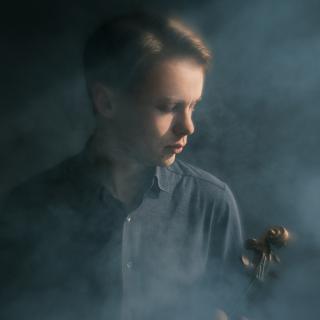
Otto Antikainen, who charmed the audience at the final of the most recent Jean Sibelius Violin Competition, is an insightful interpreter of Englund's bitterly humorous concerto.
The Danish conductor Thomas Dausgaard loves his countryman Carl Nielsen’s music; “I’ve known Nielsen’s music from as early as I can remember, with the fondest memories from my grandmother who knew and studied with him.” To Helsinki, Dausgaard brings a Norwegian-Finnish-Danish programme that opens with Lasse Thoresen's tone poem journeying from idyll and storm toward radiance, and closes with Nielsen's ecstatic First Symphony.
The soloist for Einar Englund's bitterly humorous violin concerto is Otto Antikainen, the Finnish finalist at the latest Jean Sibelius Violin Competition.
Lasse Thoresen: Rettferdighetens sol (The Sun of Justice), Op. 12
Norwegian composer Lasse Thoresen (b. 1949) studied in Norway, the Netherlands and France. He has been Professor of Composition at the Norwegian Academy of Music for many decades. His output includes orchestral pieces, solo concertos, chamber music, vocal music and electroacoustic works. He has been commissioned for instance by the Oslo Philharmonic, the Grieg Trio and the Norwegian Broadcasting Company. He has won several composition prizes and was awarded the Music Prize of the Nordic Council in 2010.
Thoresen favours exquisite colours and expressive moods. His music shows the influence of Messiaen, of the tuning theories of Harry Partch and of folk music from various cultures. He has written several works rooted in the Bahá’i faith, whose core ideas include equality and the immortality of the soul. The tone poem Rettferdighetens sol (The Sun of Justice) is one of these. The piece was written to a commission from the Bergen Philharmonic Orchestra and premiered in Bergen in December 1982. It is based on a prophecy made by Bahá’u’lláh, the founder of the Bahá’i faith, of a world where life is difficult until the sun of justice finally rises. The building blocks of the piece include a South American tune, Bruckner’s Te Deum and Richard Strauss’s tone poem Also sprach Zarathustra.
Einar Englund: Violin Concerto
Symphonies and concertos form the backbone of the output of Einar Englund (1916–1999). His series of concertos began with the Cello Concerto (1954), which received a prize in a competition organised by the Finnish Cultural Foundation, and ended with his last ever work, the Clarinet Concerto (1991). His Violin Concerto (1981), the fifth of his concertos, was commissioned by the Association of Finnish Symphony Orchestras and premiered at the Tampere Orchestra Days in 1982. The soloist was Kaija Saarikettu, and the Tampere Orchestra was conducted by Paavo Rautio. The premiere was a great success, and the recording made of the piece attracted international attention.
Englund was always keen to stress how much his music had to do with his personal experiences in the Continuation War: he was in the Battle of Bengtskär Lighthouse in 1941 and at the front on the Isthmus of Karelia fighting for Finland’s independence from 1941 to 1944. His music is often dramatic and colourful, and this is true in part of the Violin Concerto as well, even though it is fundamentally lyrical; Englund wished to accommodate the melodic properties of the solo instrument as well.
The concerto has three movements, as per the classical model. The first goes through both grimly determined and unreservedly romantic moments. The sombre tones of the slow movement may reflect wartime memories. The brisk finale was described by Englund himself as having a ‘Mozartean lightness’.
Carl Nielsen: Symphony No. 1 in G minor, Op. 7
The symphony cycle of Carl Nielsen (1865–1931) is often compared to that of Jean Sibelius, and not merely because they were exact contemporaries. The differences between the two reflect the differences in their character. Sibelius’s symphonies often delve into melancholy and introspection, but Nielsen was too interested in real life and its phenomena to dwell on private problems. He was an objective optimist by nature, viewing any obstacle as an opportunity rather than a disaster.
Nielsen wrote the first of his six symphonies in 1890–1892. Dedicated to his wife Anne Marie, his First Symphony was premiered at a concert of the Royal Danish Orchestra in Copenhagen in March 1894 and was excellently received. Critics remarked on both the technical proficiency and unforced expressive idiom of the composer as well as on his bold treatment of harmony. One critic, Charles Kjerulf, associated this with “a child playing with dynamite”.
Nielsen’s First Symphony is a youthful work that owes something to the Classical-Romantic idiom of Johannes Brahms but already shows the hallmarks of an original style. The progressive tonality of the work is worthy of mention: while the main key is G minor, C major plays a significant role in the tonal architecture of the piece, and at the end of the energetic finale it is C major that wins the day.
Christian Holmqvist
Translation: Jaakko Mäntyjärvi
Thomas Dausgaard
Danish conductor Thomas Dausgaard studied piano and composition from an early age with a former pupil of Carl Nielsen and later expanded his interests to cello, percussion and conducting. After studies at the Royal Danish Academy of Music and the Royal College of Music in London, he attended masterclasses with Franco Ferrara and Leonard Bernstein before serving as Assistant Conductor to Seiji Ozawa at the Boston Symphony Orchestra.
Today, Dausgaard is Principal Guest Conductor of the RTVE Symphony Orchestra and Honorary Guest Conductor of Copenhagen Phil. He previously led the BBC Scottish Symphony Orchestra, Swedish Chamber Orchestra and Danish National Symphony Orchestra, where he now holds the title of Honorary Conductor.
Known for his inventive programming, Dausgaard has championed rarely performed works by Danish women composers such as Hilda Sehested and Nancy Dalberg and developed projects linking classical music with folk music.
Otto Antikainen
Finnish violinist Otto Antikainen (b. 1990) gained national attention as the only Finnish finalist of the 2025 International Jean Sibelius Violin Competition, where his performance was praised for its architectural clarity and compelling musical vision. He has appeared as soloist with the Finnish Radio Symphony Orchestra, Ostrobothnian Chamber Orchestra, Joensuu City Orchestra and Kuopio Symphony Orchestra.
Recent engagements have included appearances with Sinfonia Lahti, Jyväskylä Sinfonia and Saimaa Sinfonietta. An active chamber musician, he has performed at festivals including Kuhmo Chamber Music and Tampere Chamber Music.
Antikainen won the Juhani Heinonen Violin Competition in 2016, placed third at the Kuopio Violin Competition in 2020 and received special prizes at the Menuhin and Carl Flesch competitions. He performs on a 1760 Giovanni Battista Guadagnini violin on loan from the Finnish Cultural Foundation.