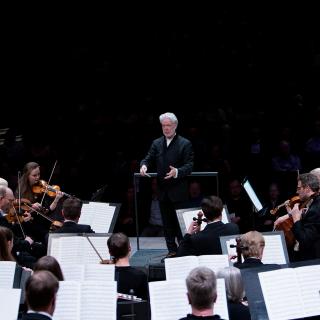
Jukka-Pekka Saraste together with the HPO and their guest artists lead the concert season to its climax with the help of maximalist Mahler.
Gustav Mahler’s Third Symphony has an abundance of everything: musicians, singers, trumpets, percussion instruments, birdsong, country dances, military marches, sunshine, nocturnal moods. There is even an abundance of movements: six!
The composer even imagined that the work could be titled Pan, both in the sense of “everything” and as a reference to the Greek mythological god who ruled over forests, pastures, shepherds, livestock and fertility. The Third Symphony opens with a fanfare played by eight French horns. The introduction is as passive as a summer day, marked by oppressive heat without the slightest breeze. The air trembles and vibrates.
The concert is organised in cooperation with The LEAD! project.
https://leadorchestraproject.com
Gustav Mahler: Symphony no. 3 in D minor
Gustav Mahler (1860–1911) observed in a famous quote that a symphony should contain the entire world. The best and most extreme manifestation of this tenet is his Symphony no. 3. It is the most extensive in a series of extensive works, clocking in at about 100 minutes, and has six movements. Its huge performing forces include not only a very large orchestra but also a vocal soloist, a women’s choir and a children’s choir.
Mahler wrote the Symphony in stages over a period of several years. It was premiered in Krefeld in summer 1902 with Mahler himself conducting and was a great success. The movements originally had descriptive headings, although Mahler later deleted them: 1. Pan Awakes, Summer Marches In; 2. What the Flowers in the Meadow Tell Me; 3. What the Animals in the Forest Tell Me; 4. What Man Tells Me; 5. What the Angels Tell Me; 6. What Love Tells Me. These titles indicate that the Symphony traces a spiritual process beginning with the tangible world and transcending to an immaterial dimension.
The huge first movement is a series of dramatic and rollicking marches. The second is a sensitive minuet. The third is a scherzo, interrupted on two occasions by the nostalgic, dreamy music of a ‘posthorn’ (generally substituted by a flugelhorn or trumpet in performance).
A human voice is introduced in the fourth movement, with a solo voice singing a poem from Nietzsche’s Also sprach Zarathustra. In the fifth movement, children sing of the Kingdom of Heaven in a setting from a naïve poem from the folk poetry collection Des Knaben Wunderhorn. The finale is an expansive Adagio that ascends to embrace the entire universe.
Jukka-Pekka Saraste
Jukka-Pekka Saraste, Chief Conductor and Artistic Director of the Helsinki Philharmonic Orchestra, has established himself as one of the outstanding conductors of his generation. Born in Finland in 1956, he began his career as a violinist. Today, he is renowned as an artist of exceptional versatility and breadth.
Saraste has previously held principal conductorships at the WDR Symphony Orchestra in Cologne, the Oslo Philharmonic Orchestra, the Finnish Radio Symphony Orchestra, the Toronto Symphony Orchestra, and the Scottish Chamber Orchestra, and has served as Principal Guest Conductor of the BBC Symphony Orchestra. As a guest conductor, he appears with major orchestras worldwide, including the Orchestre de Paris, the London Philharmonic Orchestra, the Staatskapelle Berlin, the Cleveland Orchestra, the New York Philharmonic Orchestra, and the Symphony Orchestras of Boston, Chicago, and San Francisco.
Coaching and mentoring young musicians is of great importance to Saraste. He is a founding member of the LEAD! Foundation, a mentorship programme for young conductors and soloists.
www.jukkapekkasaraste.com
Karen Cargill
Scottish mezzo Karen Cargill has earned wide acclaim on major operatic stages, including the New York Metropolitan, Covent Garden, the Deutsche Oper Berlin and Glyndebourne. Equally established on the concert stage, she regularly appears with conductors such as Sir Simon Rattle, Daniel Harding, Yannick Nézet-Séguin, Robin Ticciati, Rafael Payare, and Edward Gardner. Cargill also sings Lieder with her regular recital partner Simon Lepper.
In the current seson, Cargill’s operatic engagements include Judith in Bartók’s Bluebeard’s Castle at the Canadian Opera Company and Adelaide in Strauss’ Arabella at the Metropolitan Opera. She has recently sung Geneviève in Debussy’s Pelléas et Mélisande with Ryan Wigglesworth and the BBC SSO and Waltraute in Wagner’s Götterdämmerung with Patrick Hahn and the Sinfonieorchester Wuppertal. In June, she joins the Bergen Philharmonic Orchestra and Esa-Pekka Salonen as the soloist in Mahler’s Symphony No. 2.
Cantores Minores
Cantores Minores (est. 1952) is the largest and most professional boys' choir in Finland. The Choir draws its inspiration strongly from the German protestant boys' choir tradition. More than 400 boys and young men participate in the choir's activities every year. Cantores Minores has also been granted significant recognition: 2014 the Finnish State Music Committee awarded the choir the State Prize for Music.
Cantores Minores performs not only in its home country but also abroad. The choir has made 72 major concert tours to, among others, India, Japan, the United States and 23 European countries. In 2027, the choir will celebrate its 75th anniversary with several different projects both domestically and internationally.
Since 2005, professor Hannu Norjanen has been the artistic director of the Cantores Minores boys' choir and the principal of the CM Music Institute.
The President of the Republic Alexander Stubb and Mrs. Suzanne Innes-Stubb are the permanent patrons of the choir.
The Helsinki Music Centre Chorus
The Helsinki Music Centre Chorus is a symphonic choir of 130 singers that can also be transformed into a male or a female choir if necessary. The choir collaborates with the resident organisations of the Helsinki Music Centre: the Helsinki Philharmonic Orchestra, the Finnish Radio Symphony Orchestra and the Sibelius Academy of the University of the Arts Helsinki. The artistic director of the choir is the Professor of Choral Conducting Nils Schweckendiek. The choir was founded in 2011.
The choir’s repertoire consists of symphonic choral and orchestral works, complemented by a cappella works for a chorus. The repertoire covers all musical eras, including contemporary music. The programme is planned on a long-term basis in collaboration with the resident organisations of the Music Centre. The choir performs eight to ten times a year, mainly in the Helsinki Music Centre, but also elsewhere.
On the stage today
Violin 1
Pekka Kauppinen
Kreeta-Julia Heikkilä
Kari Olamaa
Eija Hartikainen
Katariina Jämsä
Maiju Kauppinen
Kati Kuusava
Ilkka Lehtonen
Jani Lehtonen
Petri Päivärinne
Kalinka Pirinen
Satu Savioja
Sirkku Helin
Rebekka Aaltola
Sari Deshayes
Sophie Heinrich
Júlia Mušáková
Seo Wonjay
Violin 2
Tami Pohjola
Anna-Leena Haikola
Teija Kivinen
Kamran Omarli
Teppo Ali-Mattila
Serguei Gonzalez Pavlova
Matilda Haavisto
Linda Hedlund
Siiri Rasta
Krista Rosenberg
Ángeles Salas Salas
Eevi Hannonen
Lena-Marie Stöger
Yaodang Zhang
Viola
Torsten Tiebout
Oleksandr Ahafonov
Lotta Poijärvi
Dasha Auer
Petteri Poijärvi
Aulikki Haahti-Turunen
Kaarina Ikonen
Tiila Kangas
Carmen Moggach
Liisa Orava
Mariette Reefman
Markus Sallinen
Hajnalka Standi-Pulakka
Jaakko Laivuori
Cello
Tuomas Ylinen
Alexander Shirinyan
Beata Antikainen
Selma Sköld
Lauri Kankkunen
Jaani Helander
Veli-Matti Iljin
Ilmo Saaristo
Saara Särkimäki
Johannes Välja
Tommi Wesslund
Nadja Barrow
Bass
Ville Väätäinen
Eero Ignatius
Tuomo Matero
Svenja Dose
Paul Aksman
Henri Dunderfelt
Martti Genevet
Iikka Järvi
Ari Mansala
Jon Mendiguchia | Flute
Niamh McKenna
Elina Raijas
Päivi Korhonen
Jenny Villanen
Oboe
Hannu Perttilä
Jussi Jaatinen
Paula Malmivaara
Nils Rõõmussaar
Clarinet
Samuel Buron-Mousseau
Anna-Maija Korsimaa
Heikki Nikula
Hanna Hujanen
Laure Paris
Bassoon
Mikko-Pekka Svala
Erkki Suomalainen
Noora Van Dok
Alan Davidson
Horn
Ruben Buils Garcia
Ville Hiilivirta
Miska Miettunen
Mika Paajanen
Sam Parkkonen
Joonas Seppelin
Satu Huuskonen
Elías Moncholí Cerveró
Trumpet
Thomas Bugnot
Obin Meurin
Michael Olsen
Mika Tuomisalo
David Busawon
Trombone
Darren Acosta
Valtteri Malmivirta
Anu Fagerström
Jussi Vuorinen
Tuba
Ilkka Marttila
Timpani
Tomi Wikström
Mikael Sandström
Percussion
Xavi Castelló Aràndiga
Aleksi Haapaniemi
Virva Kuusi
Sampo Kuusisto
Alex Martin Agustin
Tuija-Maija Nurminen
Harp
Anni Kuusimäki
Minnaleena Jankko |