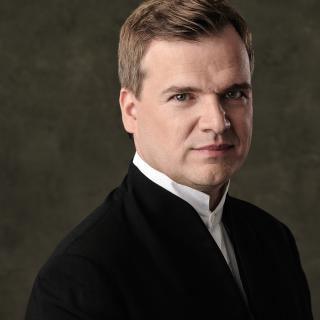
For conductor Risto Joost, Arvo Pärt is an eternal composer, as relevant in the past as in the future.
Composer Arvo Pärt has an unknown admirer who plants flowers in front of his front door every spring and autumn. “I walk through the door dozens of times a day and think of her every time. Every time I walk past the flowers, I thank her with all my heart.” Millions of people around the world have taken Pärt’s music to heart.
Dmitri Shostakovich’s last symphony is packed with references to both his own works and those of other composers. This has led to various interpretations of the symphony’s meaning: Was the composer depressed due to poor health and contemplating death? Or was he recovering and looking to a brighter future? Or perhaps he was simply summarising his life’s work.
Arvo Pärt: Swansong
Estonian composer Arvo Pärt (b. 1935) has for decades been one of the most popular composers of our time. His music speaks directly to the heart and soul through minor triads, melodies inspired by Renaissance music and pointillist rhythms evoking a cathedral-like echo effect. Pärt describes the technique with the term tintinnabuli, referring to the sound of bells. He developed this technique during his artistic transition period in the 1970s. He has noted that “tintinnabulation is an area where I sometimes stray when searching for answers — in life, in my music, in my work. In my darkest moments I feel confident that everything beyond this one thing is meaningless.”
Swansong (2014) is an instrumental version of Littlemore Tractus (2000) for choir and organ and was written for the Mozart Week in Salzburg. Pärt spent nearly two years writing the original Tractus, even though it is only about seven minutes long; he wanted to ensure that the tiny parish of Littlemore in Oxford that commissioned the piece had the full support of the Catholic, Orthodox and Anglican churches for the project.
Underlying Swansong is the most famous sermon by English Cardinal John Henry Newman (1801–1891), titled Wisdom and Innocence, particularly its concluding prayer: “May He support us all the day long, till the shades lengthen, and the evening comes, and the busy world is hushed, and the fever of life is over, and our work is done! Then in His mercy may He give us safe lodging, and a holy rest, and peace at the last!”
Arvo Pärt: Adam’s Lament
Arvo Pärt had been contemplating the writing of Adam’s Lament (2009) for more than 20 years when he finally found an occasion for composing it to be performed in Istanbul, a nexus of religions. The work was premiered at the Hagia Irene, the oldest church in the city, by Estonian and Turkish performers in June 2010.
Adam’s Lament sets a text by a Russian Orthodox monk, St Silouan of Mount Athos (1866–1938), published by his disciple Archimandrite Sofroni Sakharov (1896–1993) in the collection Staretz Silouan (1973). Silouan, who resided at the monastery of St Panteleimon in Greece, focused his teaching on loving one’s enemy, having compassion for humanity and feeling sorrow for the sins of humans. In Pärt’s setting, the mixed choir represents Silouan himself, the narrator, whose speech bookends the core of the piece, the setting for male choir of Adam’s outpouring of grief and despair on being banished from Paradise.
Pärt wrote: “For the holy man Silouan of Mount Athos, the name Adam is like a collective term which comprises humankind in its entirety and each individual person alike, irrespective of time, epochs, social strata and confession. But who is this banished Adam? We could say that he is all of us who bear his legacy. And this ‘Total Adam’ has been suffering and lamenting for thousands of years on earth. Adam himself, our primal father, foresaw the human tragedy and experienced it as his personal guilt. He has suffered all human cataclysms, unto the depths of despair.”
Dmitrij Sjostakovitj: Symfoni nr 15
År 1971 var Dmitrij Sjostakovitj (1906–1975) en respekterad och nationellt hyllad tonsättare. Hans rykte som en enfant terrible hörde till det förgångna. De senaste åren hade dock varit svåra: Sjostakovitj var ständigt på sjukhus och hans musiks ämnessfär kretsade kring döden. Trots detta planerade han att skriva en ”glad symfoni”. Men den femtonde symfonin (1971) blev ett verk präglat av en gåtfull pendling mellan verklighet och dröm. Det är knappast överraskande att verkets speciella atmosfär inspirerade den surrealistiska filmens mästare David Lynch då han gjorde sitt genombrott, Blue Velvet (1986).
Det är alltid ofrånkomligt att tolka Sjostakovitjs symfonier utgående från hans livsskeden. Vad gäller den femtonde symfonin råder ingen brist på vilt fantastiska tolkningar. Eftersom symfonin blev tonsättares sista, och musiken innehåller citat ur bl.a. Rossinis Wilhem Tell, Wagners uvertyr till Tristan och Sjostakovitjs egna symfonier 4 och 7 har man uppfattat verket som både en bugning inför historien och en mot systemet riktad grimas. Framförallt har man talat om ett musikaliskt testamente.
Tonsättaren Steve Holtje har skapat en biografisk teori. Wilhelm Tell blev Rossinis sista opera: på samma sätt visste Sjostakovitj att denna symfoni blir hans sista. Dessutom är mästerskytten en hänvisning till Sjostakovitjs egen kamp för att rädda sin familj från maktens maskineri. Den andra satsens dystra bleckkoraler (jmfr. symfoni 11) och glissandon (jmfr. operan Lady Macbeth) är minnen av Stalin och tonsättarens period i onåd. Tredje satsens rytm i pukan och tonsättarens musikaliska signatur D-Ess-C-H hänvisar till den fjärde symfonin som inte fick spelas. Finalens Wagner-citat (Siegfrieds sorgmarsch och Dödsmotivet) beledsagar den sjuka tonsättarens väg till graven.
Tonsättarens egen tolkning var långt mera jordnära: ”Jag vet inte riktigt själv varför citaten är där, men jag kunde bara inte låta bli att ta med dem.” En biografisk tolkning får dock ett visst stöd av att man kan finna passager ur Richard Strauss Ein Heldenleben och Beethovens uvertyr Egmont. Symfonins sista takter har tolkats som minnen av sjukrummets maskiners tickande.
Risto Joost
Estonian conductor Risto Joost (b. 1980) is acclaimed for his artistic versatility and has gained widespread recognition for his work both in the opera pit and on the concert stage. Since the 2024/25 season, Risto Joost has served as Chief Conductor of the Württemberg Chamber Orchestra Heilbronn, and he also holds the position of Artistic Director and Chief Conductor of the Estonian National Theatre Vanemuine in Tartu. He has previously held major artistic positions such as Chief Conductor of the Tallinn Chamber Orchestra and has been a long-standing conductor of the Estonian National Opera.
Risto Joost is in demand as a guest conductor with orchestras such as the Helsinki Philharmonic, Bergen Philharmonic, Norwegian National Opera Orchestra, Tampere Philharmonic, and Tapiola Sinfonietta. Between the 2026 and 2029 seasons, he will present Richard Wagner’s Ring cycle in collaboration with the Estonian National Theatre Vanemuine and the Saaremaa Opera Festival.
The Helsinki Music Centre Chorus
The Helsinki Music Centre Chorus is a symphonic choir of 130 singers that can also be transformed into a male or a female choir if necessary. The choir collaborates with the resident organisations of the Helsinki Music Centre: the Helsinki Philharmonic Orchestra, the Finnish Radio Symphony Orchestra and the Sibelius Academy of the University of the Arts Helsinki. The artistic director of the choir is the Professor of Choral Conducting Nils Schweckendiek. The choir was founded in 2011.
The choir’s repertoire consists of symphonic choral and orchestral works, complemented by a cappella works for a chorus. The repertoire covers all musical eras, including contemporary music. The programme is planned on a long-term basis in collaboration with the resident organisations of the Music Centre. The choir performs eight to ten times a year, mainly in the Helsinki Music Centre, but also elsewhere.
www.musiikkitalonkuoro.fi
On the stage today
Violin 1
Kreeta-Julia Heikkilä
Sara Etelävuori
Elina Viitasaari
Eija Hartikainen
Maiju Kauppinen
Kati Kuusava
Helmi Kuusi
Elina Lehto
Kari Olamaa
Petri Päivärinne
Kalinka Pirinen
Satu Savioja
Celina Blasco Bronisz
Sanna Kokko
Öykü Melis Sahin
Pia Sundroos
Violin 2
Kaia Voitka
Kamran Omarli
Teija Kivinen
Teppo Ali-Mattila
Heini Eklund
Serguei Gonzalez Pavlova
Linda Hedlund
Liam Mansfield
Siiri Rasta
Krista Rosenberg
Ángeles Salas Salas
Virpi Taskila
Ruben Goesch
Emmi Peltola
Viola
Torsten Tiebout
Lotta Poijärvi
Petteri Poijärvi
Aulikki Haahti-Turunen
Kaarina Ikonen
Tiila Kangas
Ulla Knuuttila
Mariette Reefman
Markus Sallinen
Hajnalka Standi-Pulakka
Ana Robles Galindo
Julie Svacinová
Cello
Lauri Kankkunen
Tuomas Ylinen
Saara Särkimäki
Jaani Helander
Veli-Matti Iljin
Jaakko Rajamäki
Ilmo Saaristo
Johannes Välja
Tommi Wesslund
Woo Suk Jeong
Bass
Ville Väätäinen
Tuomo Matero
Eero Ignatius
Paul Aksman
Adrian Rigopulos
Henri Dunderfelt
Taavi Korhonen
Maria Krykov | Flute
Elina Raijas
Päivi Korhonen
Jenny Villanen
Oboe
Hannu Perttilä
Jussi Jaatinen
Cristian Moré Coloma
Clarinet
Samuel Buron-Mousseau
Anna-Maija Korsimaa
Helmi Malmgren
Bassoon
Mikko-Pekka Svala
Noora Van Dok
Horn
Ruben Buils Garcia
Ville Hiilivirta
Mika Paajanen
Joonas Seppelin
Trumpet
David Busawon
Mika Tuomisalo
Trombone
Valtteri Malmivirta
Anu Fagerström
Jussi Vuorinen
Tuba
Ilkka Marttila
Timpani
Tomi Wikström
Percussion
Xavi Castelló Aràndiga
Pasi Suomalainen
Tommi Kiiski
Virva Kuusi
Tuija-Maija Nurminen
Elmeri Uusikorpi
Harp
Anni Kuusimäki
Minnaleena Jankko |