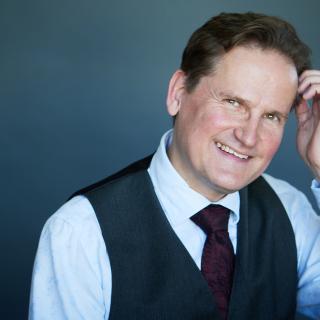
The supernatural world, mystery, black magic and mysticism have all inspired the composers featured in this concert conducted by Olli Mustonen.
Mustonen’s Third Symphony draws its text from the Kalevala. “As much of it is simply impossible to translate, I have felt that with the help of music it could be possible also to convey some of the untranslatable and at times even hypnotic and shamanistic qualities of this poetry to an audience not fluent in our unusual language,” Mustonen says.
Sergei Prokofiev composed his Third Symphony from the same powerful materials that he used for his opera The Fiery Angel. The symphony is dominated by the opera’s dark atmosphere, which draws its tone from black magic and superstition, sexual obsession, devilish ghosts and the epic battle between good and evil.
Anatoli Lyadov: Kikimora, Op. 63
Anatoli Lyadov (1855–1914) was a teacher of composition and music theory at the St Petersburg Conservatory, where his pupils included Serge Prokofiev and Nikolai Myaskovsky. As a composer, Lyadov had no shortage of ideas. Where he did fall short was on patient, sustained work, and he only completed a small number of compositions. It is also scarcely surprising that most of these are brief miniatures for piano or orchestra. None of his planned extensive works, such as an opera about the Apocalypse, ever progressed beyond the idea stage. His procrastination ruined any chances he might have had of making a name for himself beyond Russia. When the Ballets Russes commissioned a new piece from him in 1909, nothing happened. The commission was then diverted to a young gentleman named Igor Stravinsky, who delivered Firebird.
Kikimora (1909) is one of Lyadov’s most popular orchestral pieces. It is based on the legend of a malevolent witch who lives in the cellar or behind the stove and loves to create disturbances and break dishes. In Lyadov’s version, the witch grows up in the mountains, takes an interest in the rest of the world and begins to terrorise it. This is a brief piece but a celebration of rich orchestral colour and ominous moods.
Christian Holmqvist Translation: Jaakko Mäntyjärvi
Olli Mustonen: Symphony No. 3 ‘Taivaanvalot’ (Heavenly lights)
Olli Mustonen (b. 1967) has created an international career, initially as a pianist and later as a conductor. He also found a creative outlet in writing music since childhood: he went to study composition with Einojuhani Rautavaara in the 1970s. Mustonen’s musical idiom has Neo-Classical, minimalist and colourfully fantastic characteristics that in some way recall the music of his mentor, Rodion Shchedrin. Many of Mustonen’s works are rooted in national topics and folk tradition, leading to him being described as a “modern National Romantic”. His output consists mostly of orchestral and chamber music. In 2014, the Helsinki Philharmonic Orchestra premiered his Symphony no. 2, Johannes Angelos, commissioned by the orchestra, with Mustonen himself conducting.
Symphony no. 3, Taivaanvalot (Heavenly lights), was first performed as a chamber music work for tenor, cello and piano in 2016, but it was conceived from the first as a piece for tenor and orchestra. This final version was premiered in Turku in 2022 with Ian Bostridge as soloist and the Turku Philharmonic Orchestra conducted by Mustonen himself. The Symphony is based on a story from the Finnish national epic, the Kalevala: the Mistress of Pohjola captures the Sun and the Moon and locks them away, leaving the people of Kalevala in darkness. The text set comes from the English translation by Keith Bosley. The work is cast in a single movement and progresses mosaic-like from one scene to the next, concluding in a vocalise that conjures forth a sunrise.
Christian Holmqvist Translation: Jaakko Mäntyjärvi
Sergei Prokofiev: Symphony No. 3 in C minor, Op. 44
In 1918, Sergei Prokofiev (1891–1953) left Russia to create an international career as a pianist and a composer. When the Chicago Opera commissioned him to write The Love for Three Oranges, he was excited enough to begin planning his next opera as well. He completed The Fiery Angel in 1927. There was a plan to premiere it in Berlin, but this project fell through. Prokofiev made several unsuccessful attempts to have the opera performed at other opera houses, and in the event The Fiery Angel was not given its premiere until after his death.
Annoyed by this score not generating any interest, in late 1928 Prokofiev wrote a Symphony in C minor based on material from the opera. The Symphony was premiered in Paris under Pierre Monteux in spring 1929.
The Fiery Angel is based on a Gothic novel by Valeri Bryusov. The main character, Renata, feels an erotic attraction to a fiery angel – though it is never made clear whether the angel is real or not. The story includes a duel, black magic and an orgy of nuns. At the end, the Inquisition sentences Renata to be burned at the stake. The music of the opera is just as fierce as one might imagine based on the above description. Prokofiev used several motifs from the opera, including those related to Renata, as the basis for developing new motifs. He did not, however, dilute any of the raw expressive power of The Fiery Angel, and with the exception of the lyrical second movement, the music varies between feverish and explosive.
Christian Holmqvist Translation: Jaakko Mäntyjärvi
Olli Mustonen
Olli Mustonen is a rare phenomenon in today’s musical life, combining careers as composer, pianist and conductor in the tradition of musicians such as Rachmaninov, Busoni and Enescu. From 2023 to 2025 he served as Principal Guest Conductor of the Lapland Chamber Orchestra, following his tenure as Artistic Director of the Turku Philharmonic Orchestra.
Mustonen made his conducting debut with the Helsinki Philharmonic in 1998 and has since appeared regularly as both conductor and pianist. The Helsinki Philharmonic also gave the premiere of his Symphony No. 2 in 2014.
Internationally, Mustonen has performed with many of the world’s leading orchestras, including the Berlin, New York and Los Angeles Philharmonics, the Chicago Symphony Orchestra, Cleveland Orchestra, Royal Concertgebouw Orchestra, Orchestre de Paris and Tonhalle-Orchester Zürich.
Ian Bostridge
Ian Bostridge CBE (b. 1964) has enjoyed an extraordinary career, appearing at many of the world’s leading concert halls, opera houses and festivals. Particularly celebrated as an interpreter of Schubert and Britten, he has performed at the Salzburg, Edinburgh, Munich, Vienna, Aldeburgh and Schwarzenberg festivals, as well as Carnegie Hall, the Bayerische Staatsoper, La Monnaie and Teatro alla Scala.
His recordings have won numerous international awards and received 15 Grammy nominations. Highlights include Schubert’s Winterreise with Thomas Adès, winner of the 2020 International Classical Music Award, Die schöne Müllerin with Graham Johnson, Tom Rakewell in Stravinsky’s The Rake’s Progress under Sir John Eliot Gardiner, and Belmonte in Mozart’s Die Entführung aus dem Serail under William Christie.
An acclaimed author and scholar, Bostridge earned a doctorate in history from Oxford University. In 2004, he was appointed Commander of the Order of the British Empire (CBE).